We use cookies to improve your experience on our platform. By clicking “Accept all cookies”, you agree to the storing of cookies on your device to enhance site navigation, analyze site usage and assist in our marketing efforts.
Cookies required for basic website functionality.
Cookies used to deliver content most relevant to you and your needs.
Cookies used to deliver content most relevant to you and your needs.
Cookies that help understand the performance of the website, how users interact with it and to identify bugs.
How is Zeffy free?
How is Zeffy free?
Zeffy relies entirely on optional contributions from donors. At the payment confirmation step - we ask donors to leave an optional contribution to Zeffy.
New York Raffle Laws for Nonprofits: License, Online Sales and 50/50 Rules (2026)
August 3, 2026
⚡TL;DR — The Short Answer
Verdict: Raffles are legal in New York for an authorized organization. Selling the tickets online is a yes, behind two Gaming Commission approvals in most cases: an approved Internet Raffle Application, plus Raffle Consent Forms (GC-RCF) if you sell outside your own municipality. Selling in person and taking a card is a yes too, because the Commission allows cash, checks and debit or credit cards.
What works: New York permits online raffle ticket sales for authorized nonprofits. Raffles with anticipated net proceeds under $5,000 per raffle and under $30,000 across the calendar year do not need a license or a financial report.
What doesn't: Online sales still need Gaming Commission approval no matter how small the proceeds. And because online reach almost always crosses municipal lines, most online sellers need a second approval (GC-RCF) on top of the Internet Raffle Application.
Best for: Nonprofits that have existed at least one year with a clear charitable purpose and can absorb the 60-day Internet Raffle Application lead time.
Worth considering if: You expect proceeds to cross the $5,000-per-raffle or $30,000-annual category thresholds, or you plan to sell tickets to anyone outside your home municipality.
New York is one of the rare clean yeses for online nonprofit raffles. But "yes" has two doors, not one, and most guides only walk readers through the first. Any organization selling raffle tickets online almost certainly reaches beyond its own municipality, which means the Internet Raffle Application and the GC-RCF Raffle Consent Form are both required, not either/or.
This guide walks a small-nonprofit volunteer through the whole checklist: whether your raffle even trips the license threshold, which forms and in what order, and what to file after the drawing. If you want the mechanics of running the raffle itself, see our guide on how to run a raffle.
The state of New York's Charitable Gaming Division defines a nonprofit raffle as:
… games in which a participant pays money in return for a ticket or other receipt and a raffle prize is awarded based on a randomly selected winning number(s), color(s), or symbol(s) designated on the ticket or receipt.
Are raffles legal in New York?
Yes. To host a raffle in New York, you must be an authorized charitable organization (nonprofit) that has served its community for at least one year before applying for a license.
Good to know: organizations running raffles with anticipated net proceeds under $5,000 per raffle and under $30,000 across the calendar year do not need to register with the Commission. If the raffle is expected to generate $5,000 or more in net proceeds, the organization must obtain a Games of Chance Identification Number from the Commission. Once received, all forms and license documents must include that number.
Authorized organizations must have existed for at least one year and maintain current membership rosters.
All proceeds must go to the lawful purposes of the authorized organization.
Authorized organizations may accept multiple forms of payment. Per the New York State Gaming Commission, "Payment for the purchase of raffle tickets may be made with cash, checks and debit or credit cards."
Authorized organizations may advertise games of chance on television and online.
Licenses must be posted where games are conducted.
No raffle tickets may be sold more than 180 days before the date of the drawing.
For a small NY nonprofit: if you expect to net under $5,000 for the raffle and under $30,000 across all your raffles this year, you have the lowest-friction fundraiser New York offers. If either number looks likely to be crossed, plan on the license path and give yourself at least two months of lead time before you plan to start selling.
Raffles vs. sweepstakes vs. lotteries: why the distinction matters
US gambling law generally turns on three elements together: consideration (something of value paid to enter), chance (winner is picked randomly, not by skill) and prize. If all three are present, the activity is a lottery, and lotteries are generally reserved to the state.
A raffle is a charitable exception carved out by state law: a nonprofit is allowed to run what would otherwise be a lottery, subject to the state's licensing rules. In New York, that carve-out lives under the Games of Chance framework.
A sweepstakes removes the "consideration" element (there is a free way to enter with the same odds of winning), which is why big-brand sweepstakes advertise "no purchase necessary." That is legally different from what a nonprofit raffle is doing.
For a small NY 501(c)(3): if you are asking supporters to pay for a ticket and awarding a prize by random draw, you are running a raffle, and New York's raffle rules apply. Do not use "sweepstakes" language to try to sidestep the license path.
How to register your nonprofit raffle in New York
Step one: apply for your Games of Chance Identification Number
To apply for a Games of Chance Identification Number, fill out and submit (together) forms GC-2, GC-2A and GC-2B, and include the $25 annual license fee.
If your organization is authorized, you will receive a Games of Chance License on form GC-5 from the clerk. You do not need to fill this form out.
Step two: to sell tickets online, get both approvals
Per the New York State Gaming Commission: "Authorized organizations wishing to sell raffle tickets online must first obtain approval of the Commission via an Internet Raffle Application." Once you have your Games of Chance ID Number from your GC-5, submit the Internet/Mobile Raffle Ticket Sales application.
Submit that application at least 60 days before you plan to start selling raffle tickets. You must submit one for every raffle you host, and every organization needs it to sell online, regardless of category.
The second approval most online sellers also need: the New York State Gaming Commission also states, "Organizations need approval to sell raffle tickets in other than the municipality within which the organization is domiciled. Approval may be obtained by filing Raffle Consent Forms (GC-RCF) with the Commission."
Selling raffle tickets online almost always reaches buyers outside your home municipality, by definition. So in practice, most nonprofits selling online need both filings: the Internet Raffle Application and the GC-RCF Raffle Consent Form. If you have questions on the trickier sections of the Internet Raffle Application, the Gaming Commission is the right contact.
For a small NY nonprofit: if you cannot line up a 60-day lead time for the Internet Raffle Application before your event, run this year's raffle in-person only within your home municipality and file the online paperwork now for next year.
Nonprofit raffle categories in New York
When applying for your Games of Chance Identification Number, you must select Category 1 or Category 2 on your application form.
Category 1
If you think all your raffles for the calendar year will net at least $30,000, or any one raffle will net between $5,000 and $29,999, select Category 1.
Category 2
You do not need to apply for a license or submit a financial report for individual raffles with anticipated net proceeds under $5,000, or for all raffles under $30,000 within a calendar year.
For a small NY nonprofit: Category 2 is the practical starting point. If your projections are close to either threshold, budget conservatively and file for Category 1 rather than risk being over-threshold with no license.
Are 50/50 raffles legal in New York?
Yes. A 50/50 raffle, where the winner takes half the pot and the nonprofit keeps the other half, is legal for authorized organizations in New York under the same Games of Chance framework as any other raffle. That means the same rules apply: the $5,000/$30,000 category thresholds decide whether you need a license, and the two Gaming Commission approvals (Internet Raffle Application and, in practice, GC-RCF) apply if you want to sell 50/50 tickets online.
New York does add one ticket-format rule specific to 50/50s: each part of the two-part "admission-style" ticket must show an identical, consecutively printed ticket number, so you can verify the winning stub against the drum.
For a small NY nonprofit: 50/50s are a great low-friction option for in-person events, but the online path is exactly the same as a regular raffle. Do not assume 50/50s are exempt from the Internet Raffle Application.
What needs to appear on your nonprofit's raffle tickets
50/50 raffle tickets
To verify the winning ticket, each part of a two-part "admission-style" ticket used for a 50/50 raffle needs to show an identical, consecutively printed ticket number.
Regular raffle tickets
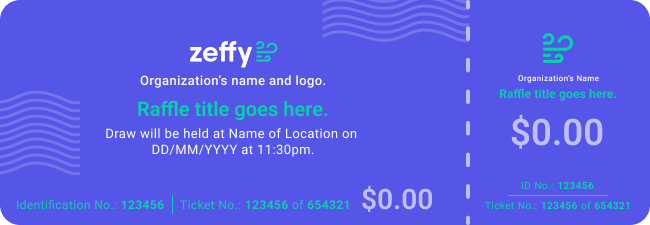
Raffle tickets in New York must clearly display:
The name and Games of Chance Identification Number (if you have one) of the authorized organization.
The location(s), date(s) and time(s) of the drawing(s).
The consecutively printed serial number of the ticket.
The price of the ticket.
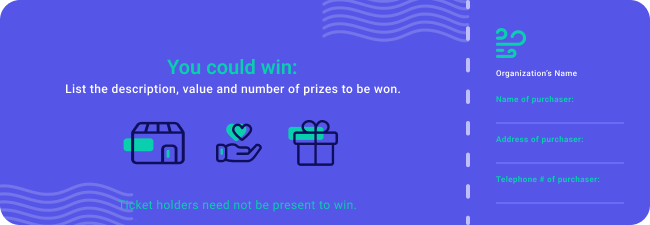
A list of the prizes offered.
The statement: "Ticket holders need not be present to win."
On each ticket stub or receipt: the name, address and telephone number of the ticket purchaser and the ticket's consecutively printed serial number.
Does it cost anything to register?
An annual license fee of $25 is associated with forms GC-2, GC-2A and GC-2B.
If you fall into Category 1, the municipal clerk (or county fiscal officer) may need to be paid an additional license fee of 2% of the reported net raffle proceeds over $30,000. No additional license fee is paid on the first $30,000 of net raffle proceeds. So if your raffle earned $35,000, your nonprofit would owe an additional $100 (2% of $5,000).
For a small NY nonprofit: the $25 filing fee is the real cost of getting licensed. Everything else scales with success, which is a good problem to have.
After the raffle: GC-7R and recordkeeping
Your work does not end when the last ticket stub is drawn. If your nonprofit falls into Raffle Category 1, you must file a financial statement of raffle operations on Form GC-7R with the municipal clerk and the Commission by January 30 of the following year.
To make GC-7R painless, keep clean per-participant records from day one: who bought how many tickets, when, at what price, and any prize awarded. If you sold online through a platform, that record already exists. If you sold offline, log it as you go, not at year-end.
For a small NY nonprofit: the January 30 deadline sneaks up on people. Put it on the calendar the day the drawing ends, and pull your participant list before you close out the raffle.
Federal tax layer: W-2G, withholding and UBIT
New York's rules are only the state layer. Federal rules apply too. This is a short overview, not tax advice: talk to a CPA about your specific situation.
Reporting winnings. The IRS uses Form W-2G to report certain gambling winnings, including some raffle prizes. Reporting thresholds vary by gambling type. See IRS Form W-2G and IRS Publication 3079 for the specifics.
Federal withholding on big prizes. Per IRS Publication 3079, when proceeds from a raffle wager exceed $5,000, the applicable federal withholding rate is 24%.
Unrelated Business Income Tax (UBIT). Raffle proceeds can trigger UBIT for a 501(c)(3) if gaming is regularly carried on, is not substantially related to the exempt purpose, and no exclusion (such as substantially all volunteer labor) applies. See IRS Publication 3079 (Chapter 2) and IRS Publication 598.
For the full national picture across all 50 states, see our state-by-state raffle law guide. This page is New York only.
For a small NY nonprofit: if your raffle grand prize is over $5,000 in value, the federal withholding rules matter. If it is a $200 gift basket, they generally do not. Either way, keep records.
Common NY raffle compliance mistakes
Advertising or selling tickets before your GC-2/2A/2B is on file. If your raffle is going to cross the $5,000 or $30,000 category threshold, the license needs to come first.
Selling online without the Internet Raffle Application. This is required regardless of the amount of proceeds.
Skipping the GC-RCF. If online buyers can reach you from outside your home municipality (and they almost always can), you need the GC-RCF as well.
Missing the January 30 GC-7R deadline. Category 1 orgs must file the financial statement of raffle operations by January 30 of the year after the drawing.
Selling to minors. New York's charitable-gaming rules restrict who may participate. Check age eligibility before you sell.
Selling more than 180 days before the drawing. No raffle tickets may be sold more than 180 days before the scheduled occasion.
For a small NY nonprofit: most of these are calendar problems, not legal problems. Put the 60-day Internet Raffle Application lead time, the drawing date and the January 30 GC-7R deadline on a shared calendar before you start selling anything.
Can you use Zeffy to run online raffles in New York?
Are raffles legal in New York? Yes, for an authorized organization that has served its community for at least a year. Can you sell raffle tickets online? Yes, once the Commission has approved your Internet Raffle Application, and once you have filed Raffle Consent Forms (GC-RCF) if you sell outside your own municipality. Can you sell them in person and take a card? Yes, the Commission allows cash, checks and debit or credit cards.
So yes, once both New York approvals are in hand. Zeffy is a free fundraising platform used by 100K+ nonprofits, and $2B+ has been raised on it. No platform fee, no transaction fee, no credit card fee. Ever.
Here is what Zeffy is (and is not) for a New York raffle:
Once your Internet Raffle Application and (where applicable) GC-RCF are approved, you can sell raffle tickets online through Zeffy's free online raffle platform: numbered tickets, ticket bundles, prize descriptions, participant reports and a "draw a winner" tool.
Selling tickets in person at your event, or in-municipality during the 60-day application window? You can sell tickets in person with Tap to Pay on your iPhone or Android, no card terminal, and no fees.
Recordkeeping for GC-7R. You can track ticket buyers in Zeffy's free donor CRM: one record per participant with ticket-purchase history to pull when the January 30 filing comes due.
Before both approvals are in hand, you can still use Zeffy for everything that is not the raffle itself: donation forms for supporters who prefer to give directly, event ticketing for the fundraising event where the drawing happens, and supporter email to keep participants in the loop.
Zeffy does not file GC-2, GC-2A, GC-2B, GC-RCF or the Internet Raffle Application on your behalf. Those go directly to the New York State Gaming Commission and your municipal clerk. Zeffy is the free platform for running the raffle after the state has said yes.
Recap: links and documents mentioned in this article
Yes, if it is an authorized charitable organization that has served its community for at least one year. Raffles with anticipated net proceeds under $5,000 per raffle and under $30,000 for the calendar year do not require a license, but authorized-organization status still applies.
State licensing rules and federal tax rules are separate. Raffle proceeds can trigger federal Unrelated Business Income Tax (UBIT) if the gaming is regularly carried on, is not substantially related to the exempt purpose and no exclusion applies. See IRS Publications 3079 and 598, and talk to a CPA about your specific situation.
For raffles that cross the $5,000-per-raffle or $30,000-annual threshold: GC-2, GC-2A and GC-2B (filed together, with a $25 annual fee) to get a Games of Chance ID Number, and GC-5 (issued back to you by the clerk). To sell tickets online: the Internet/Mobile Raffle Ticket Sales application, and in most cases GC-RCF as well. After a Category 1 raffle: GC-7R by January 30 of the following year.
Yes, with two approvals in most cases. The Gaming Commission requires an approved Internet Raffle Application before any online sales, and a GC-RCF Raffle Consent Form if ticket sales reach outside your home municipality (which online sales almost always do).
Yes, under the same Games of Chance framework as any other raffle, subject to the same $5,000/$30,000 thresholds and the same two online-sales approvals. 50/50 tickets have a specific format rule: a two-part admission-style ticket with an identical, consecutively printed number on each part.
Here’s a recap of all the links and documents mentioned in this article:
How to Plan and Run a Raffle Fundraiser (Free Guide + Planner)
Plan your raffle in 60 seconds with our free revenue planner. Then follow 10 steps to set up, promote, and run a raffle that keeps 100% of what you raise.
Free Online Raffle Generator & 12 Best Raffle Apps for Fundraisers
Use our free online raffle generator to draw winners instantly. Plus, compare the 12 best raffle apps and websites for nonprofits — with pricing, features, and reviews.
Look for people who attend related events, follow relevant Facebook groups, or subscribe to aligned newsletters.These aren’t just potential donors—they’re your future advocates.
Look for people who attend related events, follow relevant Facebook groups, or subscribe to aligned newsletters.These aren’t just potential donors—they’re your future advocates.






3%201.avif)


.webp)

