How is Zeffy free?

How is Zeffy free?
Zeffy relies entirely on optional contributions from donors. At the payment confirmation step - we ask donors to leave an optional contribution to Zeffy.
Learn more >
How your supporters see your nonprofit shapes whether they trust you, give to you, and stick around.
The hard part is choosing help. Some branding agencies lead with research, positioning, and messaging strategy. Others lead with visual design. Both matter, but for a small nonprofit with a tight budget, strategy-first usually beats logo-first. Getting positioning right up front prevents costly rebrands later.
Below are nine branding agencies that work with nonprofits, sorted by what they actually do best. After the list, you will find a short guide on telling strategy-led agencies from design-led ones, what nonprofit branding typically costs, and budget-friendly alternatives if a full agency engagement is not the right call yet.
For a small nonprofit: if you are under about $500K in annual revenue, read the alternatives section before you shortlist. A $15,000 to $50,000 agency engagement only pays back when you have the donor base and staff to act on the work.
Usually not yet, and that is not a knock on your nonprofit. Start with what branding is actually for. Branding is how an organization earns trust from people who will never meet anyone who works there. It is a stand-in for a personal relationship: a way to be recognized, remembered, and believed at scale, across thousands of strangers and dozens of touchpoints, when no one is in the room to vouch for you.
That is exactly why branding is mission-critical for big nonprofits. A national org raises most of its money from people with no personal connection to it. Recognition (the name, the logo, a consistent look) is what carries credibility across a TV campaign, fifty chapters, and twenty years. At that scale a few points of added trust mean large dollars, so a $50,000 rebrand pays for itself.
Small nonprofits run on the opposite engine. A PTA, a small-city tennis association, or a neighborhood animal shelter raises from people who already know them: parents, members, neighbors. Their trust is relational, not brand-mediated. One animal-rescue founder we heard from, a retired teacher running everything herself, did not have an official logo at all; her real worry was looking "profit-driven" to neighbors. That is a relationship problem, not a logo problem. At that scale a polished identity system adds little, and a $15,000 to $50,000 agency engagement comes straight out of program work.
So the honest answer for most small nonprofits: branding is hygiene, not strategy. Past a basic threshold the returns flatten fast. What you actually need is cheap and mostly DIY:
If you have genuinely outgrown that (a real donor base, staff to maintain a brand, and budget that will not eat into programs), branding becomes worth investing in, and our guide to nonprofit branding covers how to build one. The agencies below are who to call when you are there; the sections after them show how to get most of the value yourself.
Location: Washington, DC
Focus: Strategy-led (positioning, messaging, identity systems)
Price signal: Mid-market; ask about nonprofit rates
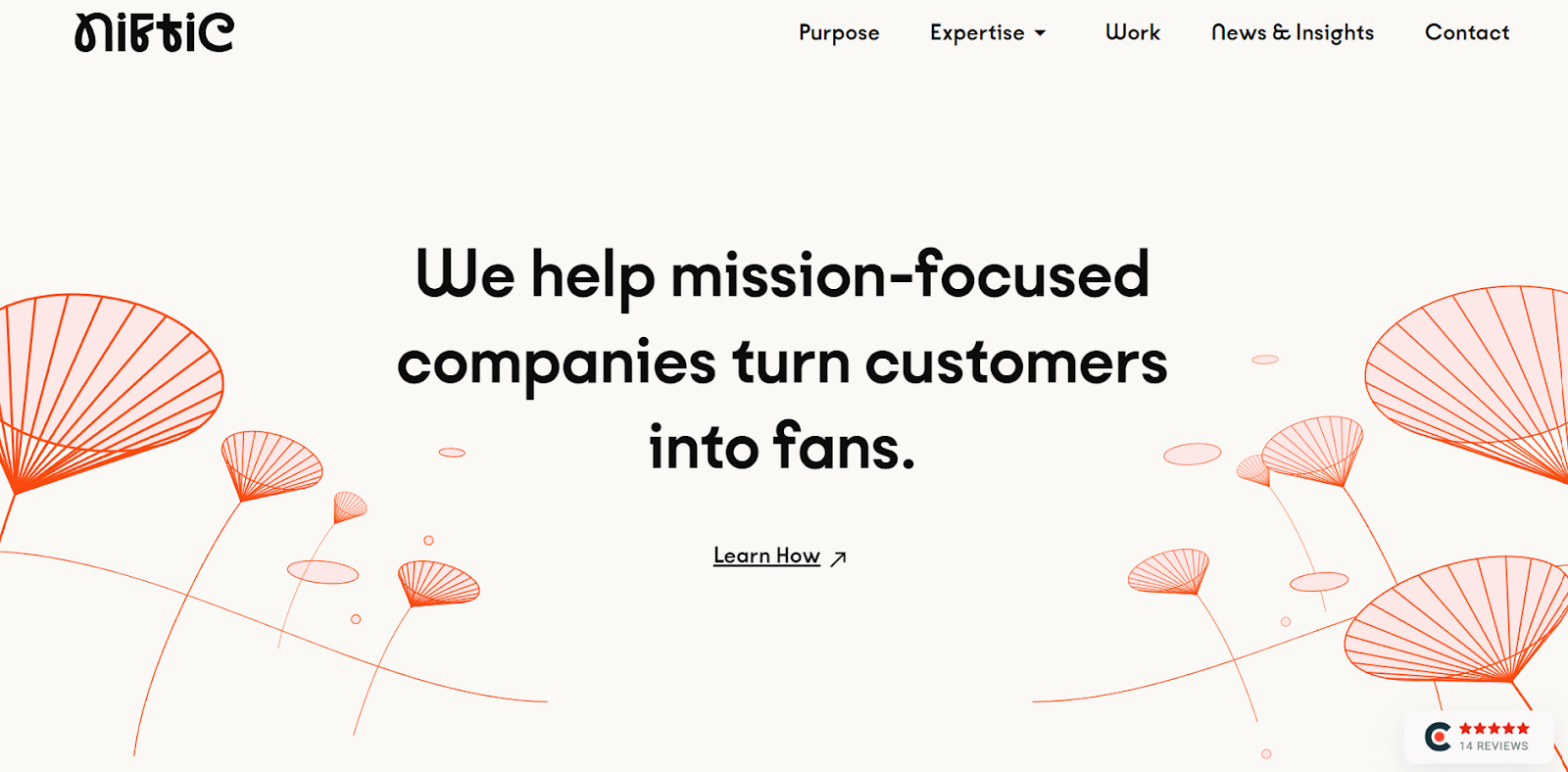
Niftic works with mission-driven brands and leads with brand strategy and positioning before any visual work. Their service menu covers verbal identity, naming, brand architecture, and storytelling alongside the visual identity system. That mix is a good fit if you want a partner who will push on your positioning, not just refresh your logo.
Key services: brand strategy and positioning, visual identity systems, naming and nomenclature, brand guidelines, verbal identity and messaging, collateral and illustration design.
Location: New York, NY
Focus: Design-led with strategic input
Price signal: Mid to upper market
DD.NYC builds bespoke brand identities and pairs visual execution with data-driven research. The work tilts toward design and digital, so they fit nonprofits that already have a clear positioning and need to translate it into a strong identity, website, or rebrand. If you are also thinking about nonprofit website design, this is the kind of agency that handles both in one engagement.
Key services: branding, rebranding, web design, packaging design, graphic design, event branding.
Location: Rolling Hills Estates, CA
Focus: Strategy plus design, scoped for small organizations
Price signal: Built for smaller budgets; phased project model
The Bureau of Small Projects exists to give small and mid-sized nonprofits the kind of brand work usually reserved for larger budgets. They use a phased project model, scoping work in steps so a small organization can move forward without committing to a full enterprise engagement up front.
Key services: brand strategy, logo design, package design, video production, design services.
Location: Washington, DC
Focus: Strategy-led, nonprofit specialist
Price signal: Mid-market
Elevation is a full-service digital agency that works exclusively with nonprofits and includes former nonprofit staff on its team. That insider lens shows up in the work, which leans toward brand strategy, positioning, and the brand style guides that help a nonprofit team stay consistent after the agency engagement ends.
Key services: brand strategy, logo design, brand style guides, graphic design, branded web design.
Location: San Francisco, CA
Focus: Strategy-led, flexible scope
Price signal: Tiered, including a lighter Quick Start option
Evviva offers branding at different scopes, from a Quick Start package for newer organizations to full strategy work for mature brands rebuilding their positioning. Their audit work is useful if your brand has drifted and you are not sure where to start.
Key services: brand strategy, brand positioning, brand naming, brand identity, brand playbook, brand audits.
Location: San Francisco, CA
Focus: Design-led with digital depth
Price signal: Upper market
Ramotion specializes in digital-first brand identities. They are a good fit for nonprofits whose donors and program participants meet the brand mostly online and who need a brand system that is built to live on a website, an app, and email from day one.
Key services: brand design, brand strategy, brand identity, rebranding, communication strategy.
Location: New York, NY
Focus: Strategy-led, with naming and verbal identity depth
Price signal: Upper market
WANT started as a naming firm and still does some of the strongest verbal identity work in the field. They cover strategy, identity, and research, and their sonic branding practice is a useful add-on if your nonprofit produces audio content or events.
Key services: brand strategy, brand naming, brand identity, research.
Location: Portland, OR
Focus: Strategy-led, purpose-driven brands
Price signal: Mid to upper market
Manifesto positions itself as a partner for purpose-driven brands and leans into deep qualitative research. The work tends to surface what makes a nonprofit different from the next ten organizations doing similar programs, which is often the missing piece for cause-driven brands.
Key services: branding and strategy, integrated campaigns, brand activation.
Location: New York, NY
Focus: Strategy plus brand experience
Price signal: Mid to upper market
Starfish treats a brand as the sum of every touchpoint a donor or program participant runs into, from an ad to a thank-you email. They audit those touchpoints, align voice and imagery, and tune the experience. That whole-system view fits nonprofits that already have decent assets but feel inconsistent.
Key services: branding, experience design, activation, culture.
For a small nonprofit: the list above skews mid to upper market. If you cannot picture writing a five-figure check for brand work right now, that is a signal, not a failure. Keep reading. Strategy-first thinking and budget-friendly paths are below.
The labels get blurry, so here is a plain-language way to tell the difference.
A strategy-focused agency starts with questions. Who are you? Who is your donor? What do you stand for that no one else does? What words do you use, and what words do you refuse to use? The visual work, logo, colors, type, comes after that, and the visuals are anchored to the answers. You leave with a brand strategy document, messaging guidelines, and a visual system that flows from both.
A design-focused agency starts with the visual. They are excellent at logos, color systems, type, and layout, and they are often faster and cheaper than a strategy-led shop. They work best when you already know your positioning and just need someone to translate it into a strong identity.
Neither is wrong. The mistake is hiring a design-led shop when what you actually need is positioning, or hiring a strategy-led shop and being shocked when the logo concepts arrive in month three.
Four questions to ask any agency before you sign:
For a small nonprofit: if an agency cannot answer question four without selling you both phases, they are probably design-led with strategy as packaging. That is fine if design is what you need. Just know what you are buying.
Branding costs vary widely and there is no clean industry standard for nonprofits specifically. Typical ranges vary by scope, agency size, and how much research the project includes.
As a rough guide:
For comparison, public branding-agency pricing data on Clutch puts general branding projects in the $10,000 to $49,000 range on average, with larger projects $50,000 and up. Nonprofit-specific pricing is not separately published, so treat any precise number as scope-dependent.
A few honest notes that matter more than the ranges:
For a small nonprofit: if the lowest realistic quote is more than three to five percent of your annual revenue, the engagement probably will not pay back. That is your cue to look at the alternatives below.
If a full agency engagement is not the right fit yet, you have three legitimate paths. None of them are second-best. They are the right answer for most small nonprofits.
Independent brand strategists often work by the hour or in scoped intensives. A four to eight hour strategy session can give you positioning, audience definition, and a messaging frame without the full agency overhead. Hourly and intensive rates vary, so get two or three quotes before committing. This works best when you already have a brand or some assets and you need outside thinking, not a from-scratch build.
The Taproot Foundation matches nonprofits with skilled volunteers across categories including design and creative work, which can cover brand-adjacent projects. Eligibility, scope, and waitlists vary, so apply early and be specific about the deliverable you want. Pro-bono is not free in time. You will spend real hours briefing the volunteers and reviewing work, and the timeline is usually slower than a paid engagement. The trade-off is often worth it for small organizations.
Most of the brand decisions that move donor trust, a clear one-sentence mission, two brand colors, one font pair, a simple logo, and a consistent voice, are decisions a founder can make in a weekend with templates. The professional work matters most where your brand actually meets donors. For a small nonprofit, that is usually the donation form, the email, and the event page, not a fifty-page brand book.
That last point is where a free fundraising platform helps. Your brand shows up to donors at the moment of giving, so the donation form, the email, and the ticket page are where consistency actually pays. Zeffy gives nonprofits customizable donation forms with your colors and logo, branded event ticket pages, newsletter and email tools to keep your brand voice consistent, and free donor management so you can segment messaging by audience. Used by 100K+ nonprofits who have raised $2B+ together, the platform is 100% free. No platform fee, no transaction fee, no credit card fee. Ever. The money you would have spent on platform fees can fund the brand work that matters.
For a small nonprofit: a tight DIY foundation plus a fractional strategist for one focused session beats a full agency engagement you cannot afford to act on. Spend on positioning, save on production.
Start with the deliverable, not the agency. Are you launching a new brand, refreshing an existing one, or just buying a logo? Write a one-paragraph brief, set a budget range, and decide whether strategy or visual identity is the priority. If you cannot decide, that is a strategy gap, and step three below matters more for you.
Ask peer organizations and board members who they worked with. Look at the agencies behind nonprofit brands you admire. Aim for a list of about ten, then cut it to four or five by reading case studies and checking that the agency has real nonprofit work in its portfolio.
A strong agency will have a clear, repeatable process that covers discovery, strategy, positioning, identity, and rollout. Ask to see a brand strategy document or messaging playbook from a past nonprofit client. If they only show you logos, they are a design shop, which may still be the right answer for your project.
Get on a call with your shortlist. You will be working closely with this team for months, so chemistry matters. During the call, ask about pricing models (project-based, retainer, phased), nonprofit rates or reduced fees, and what strategy deliverables you receive on top of visual assets. Treat the consultation as part of the evaluation. The agencies that listen well in the consultation usually listen well in the engagement.
Many agencies have reduced rates for charities. Ask. Then put the scope, deliverables, timeline, payment schedule, intellectual property rights, and revision rounds in a written contract. A clear contract protects both sides and gives you a reference point when scope creeps.
For a small nonprofit: the worst outcome is not paying too much. It is paying for an engagement you cannot implement. Tighten the scope to what your team can act on in the next twelve months.


Choose a name that reflects your nonprofit's mission. Explore our top 5 nonprofit organization name generators now.


Ready to start making an impact in your community? Learn how to start a nonprofit using these steps, plus discover how you can do it all for free with Zeffy.

.webp)


