We use cookies to improve your experience on our platform. By clicking “Accept all cookies”, you agree to the storing of cookies on your device to enhance site navigation, analyze site usage and assist in our marketing efforts.
Cookies required for basic website functionality.
Cookies used to deliver content most relevant to you and your needs.
Cookies used to deliver content most relevant to you and your needs.
Cookies that help understand the performance of the website, how users interact with it and to identify bugs.
How is Zeffy free?
How is Zeffy free?
Zeffy relies entirely on optional contributions from donors. At the payment confirmation step - we ask donors to leave an optional contribution to Zeffy.
Are There Truly Zero-Fee Fundraising Platforms? Yes, Here's the Proof
May 18, 2026
⚡TL;DR — The Short Answer
TL;DR — Truly zero-fee fundraising platforms
Yes, they exist — but they're rare. Zeffy is the primary example.
"Free" usually still costs you 2-3% per donation through Stripe or another processor.
Truly zero-fee = no platform fees AND no processing fees passed to your nonprofit. When you raise $100, you keep $100.
The savings: roughly $300-$440 per $10,000 raised, depending on your payment mix. That's money that stays with your mission.
How Zeffy stays free: optional donor tips at checkout. Donors can adjust or skip them. Nonprofits never absorb the difference.
Yes, truly zero-fee fundraising platforms exist. Zeffy is the clearest example. 100K+ nonprofits | $2B+ raised | $0 in fees through the platform — no platform fees, no transaction fees, no credit card processing fees passed to the nonprofit.
But the word "free" is doing a lot of work in this category. Most platforms that call themselves free still pass payment processing fees onto every donation, which can quietly cost a nonprofit $300 to $440 on every $10,000 raised. This article shows you what truly zero-fee actually means, which platforms qualify, and how to tell the difference.
Yes — but only a small number of platforms actually qualify. Zeffy is the primary example. It covers both platform fees and payment processing fees on behalf of nonprofits, which means a nonprofit keeps the full amount of every donation. Instead of charging nonprofits, Zeffy is funded through optional tips that donors can leave at checkout. Donors can choose to contribute, adjust the amount, or skip it entirely, and the nonprofit's revenue isn't affected either way.
That's a meaningfully different model than the rest of the "free" category. Most platforms in this space remove their own platform fee but still leave you paying 2-3% per donation through a third-party processor. The fee is real money — it just doesn't show up on the platform's pricing page.
What does truly zero-fee actually mean?
When nonprofits search for "free fundraising platforms," the question they're actually asking is: can I raise money without losing a percentage of each donation?
Truly zero-fee answers that question with yes. Specifically:
No platform fees charged to the nonprofit
No payment processing fees passed to the nonprofit
No required monthly or hidden costs
No upgrade tier locking essential features behind a paywall
When you raise $100, you keep $100 — every time, with no exceptions
Most platforms that call themselves "free" only check the first box. They drop their platform fee but still charge standard payment processing fees, typically 2.2% to 2.9% plus a flat fee of $0.30 to $0.49 per transaction. That money is still being deducted before donations reach you, even if a third party (Stripe, PayPal) is technically the one charging it.
How to spot a "free but not zero-fee" platform
Look at the fee table on their pricing page. If you see "0% platform fee" but anywhere on the same page mentions Stripe, PayPal, or "standard processing fees apply," you're looking at a free-tier-not-zero-fee platform. Examples of platforms that fit this pattern:
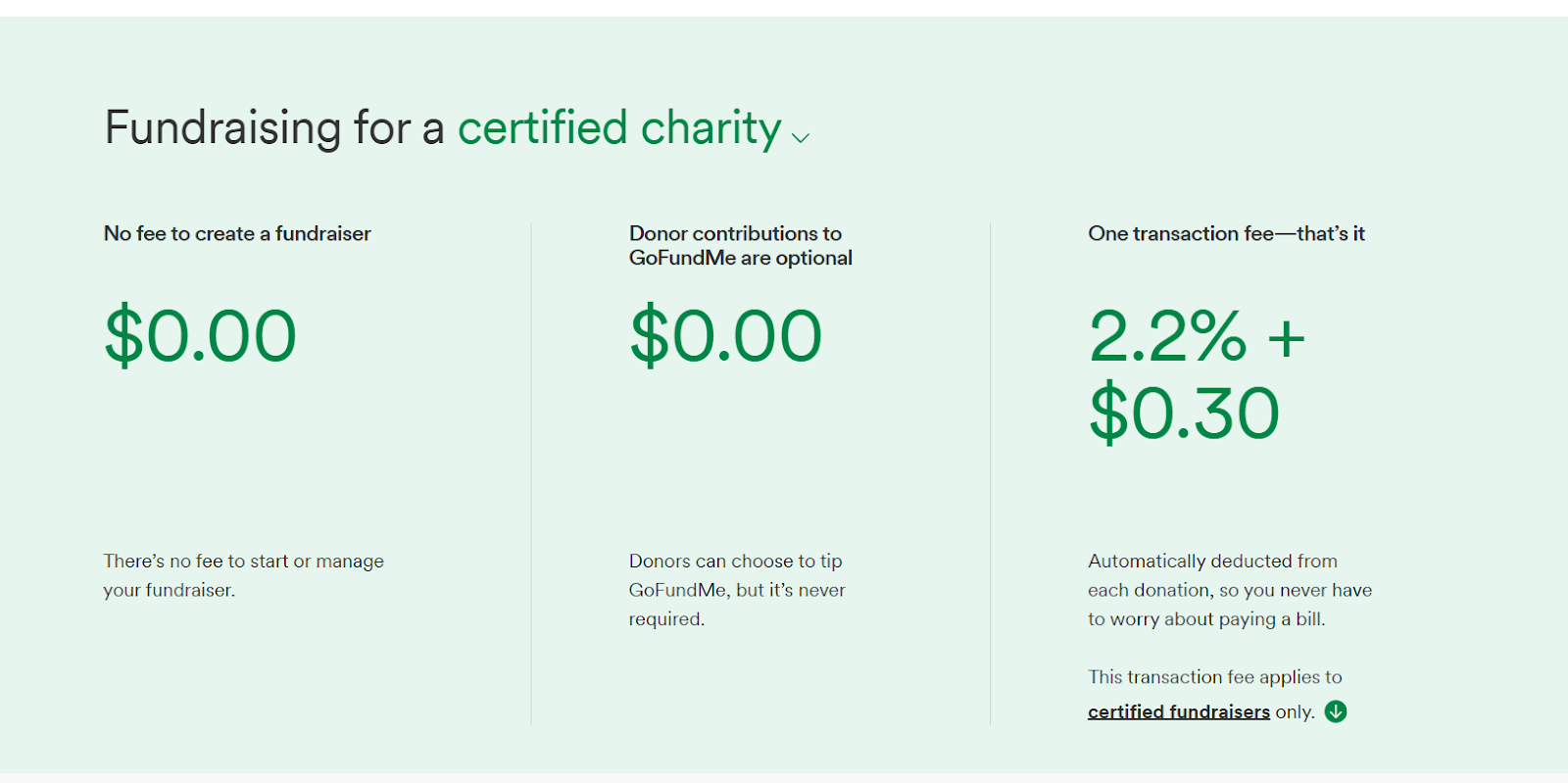
GoFundMe: No separate platform fee. Verified charities pay 2.2% + $0.30 per donation; individuals and personal campaigns pay 2.9% + $0.30. Both add an optional donor tip at checkout.
MightyCause: Same model. No platform fee, around 2.9% + $0.30 per donation through Stripe.
Give Lively: No platform fee, but every donation runs through Stripe at the nonprofit rate (around 2.2% + $0.30 with the standard nonprofit discount). For more on what this looks like in practice, see our Give Lively review.
Many other platforms follow this exact pattern. The "free" label is accurate as far as software pricing goes, but the cost of moving money is still being deducted.
See exactly what fees are costing your nonprofit
Plug your annual fundraising volume into the calculator below to see what processing fees would cost on a typical "free" platform, and what you'd keep on Zeffy.
The math is straightforward, but the totals add up faster than most nonprofits expect. On $50,000 raised through standard credit card donations, you're looking at roughly $1,400 to $1,500 in fees per year. On $250,000, it's around $7,000. None of that shows up on the platform's pricing page, because the processor is a separate vendor.
Here's how the major "free" fundraising platforms compare against truly zero-fee, on the metric that matters: how much you actually keep on $10,000 raised.
Platform
Platform Fee
Processing Fee to Nonprofit
Donor Covers Fees Option
Estimated fees on $10K raised
Truly Zero-Fee?
Zeffy
0%
0% (Zeffy covers it)
Optional donor tip
$0
✅ Yes
GoFundMe
0%
2.2% + $0.30 (charity); 2.9% + $0.30 (personal)
Yes (optional)
$340 (charity) / $440 (personal)
❌ No
MightyCause
0%
~2.9% + $0.30
Yes (optional)
~$440
❌ No
Give Lively
0%
~2.2% + $0.30 (Stripe nonprofit rate)
Yes (optional)
~$300-$370
❌ No
FreeFunder
0%
~2.9% + $0.30
Yes (encouraged tips)
~$440
❌ No
Pledge
0%
~2.9% (cards), lower for ACH
Yes (optional)
~$290-$440
❌ No
GivingGrid
0%
~2.9% + $0.30
Yes (optional)
~$440
❌ No
Estimates based on $10,000 raised across 500 donations averaging $20 each, paid by credit card. Processing fees vary by payment method, donor location, and nonprofit verification status. Some platforms offer donors the option to cover fees, but coverage is not guaranteed.
The 5 hidden fees most platforms charge
Even on platforms that advertise "no platform fee," nonprofits commonly run into five categories of cost. Each one is what Zeffy eliminates.
1. Transaction fees (processing or credit card fees)
Every credit card or digital wallet donation incurs a transaction fee from the underlying payment processor — Stripe, PayPal, Square, or another. The standard rate is 2.9% + $0.30, dropping to around 2.2% + $0.30 for verified nonprofits. On a $100 donation, that's roughly $3.20 deducted before the money reaches you. While platforms like GoFundMe and Give Lively let donors opt in to cover the fee, the nonprofit absorbs the processing cost any time a donor opts out.
On Zeffy: processing fees are covered. The nonprofit receives 100% of every donation, regardless of whether the donor leaves a tip.
2. Platform fees
Platform fees (typically 2-5%) cover the platform's own software, support, and infrastructure. Donorbox, for example, charges a 2.95% platform fee on its standard plan, with some specialized features moving to 3.95%. That's on top of payment processing.
On Zeffy: there is no platform fee. That line item simply doesn't exist for nonprofits using Zeffy.
3. Setup and monthly fees
Many platforms charge monthly subscriptions or initial setup fees on top of transaction and platform fees. These usually unlock advanced features like donor management, custom branding, or API access — features your fundraising program may actually need to scale.
On Zeffy: no setup fee, no monthly subscription, no premium tier locks. The full feature set is included from day one.
4. Payout fees
When you transfer funds to your bank account, some platforms add a fee — common ones include charges for expedited transfers, international wires, or extra monthly payouts. On top of the processor's standard rate, a platform may add 3% for instant payouts and 1.5% for international transfers.
On Zeffy: standard payouts are included at no charge.
5. Contact-based fees
Several donor management platforms charge based on the size of your donor database, with prices that climb as your contact list grows. Premium tiers gate larger lists or advanced segmentation behind upgrades.
On Zeffy: unlimited contacts, unlimited donor records, no upgrade-tier paywall.
How Zeffy eliminates all fees
If a platform calls itself truly zero-fee, it's fair to ask "what's the catch?" There isn't one. There's no required fee, no delayed charge, no scenario where the nonprofit is billed later.
Here's how the model actually works. Instead of charging nonprofits, Zeffy is sustained by voluntary tips that donors choose to leave at checkout:
When someone donates, they're given the option to add a small contribution to support the platform
The amount is suggested, but completely adjustable
Donors can increase it, lower it, or remove it entirely
The nonprofit receives 100% of the original donation in every scenario
Enough donors choose to contribute to keep the platform running, without the cost being shifted to nonprofits. For donors, leaving a small tip feels similar to covering credit card fees, rounding up a purchase, or supporting a tool they're actively using. There is no hidden fee structure on the nonprofit side, and no delayed charge.
Real nonprofits saving thousands with truly zero-fee fundraising
These are three nonprofits using Zeffy today, with the actual savings figures from their case studies.
Waggytail Rescue: $66,102 raised, $3,305 saved in fees
Waggytail Rescue is an NYC-based, all-volunteer animal rescue dedicated to saving and rehoming at-risk dogs. With high donation volume, even small per-transaction fees were stacking up against the medical care, transport, and rehoming costs that make their work possible.
It's our all-in-one platform. Adoption donations, event ticketing, medical fundraisers, raffle tickets, merch — all of it lives in Zeffy now. — Whitney, Operations Team, Waggytail Rescue
By moving to Zeffy, Waggytail keeps the full amount of every donation while running adoption fundraisers, event ticketing, and merch sales from a single platform. The fees they're no longer losing go directly toward veterinary care, transport, and the ability to take in more dogs.
The Dearborn Educational Foundation supports public school students and teachers through scholarships, classroom funding, and district-wide programs. Like many education nonprofits, they were used to seeing a portion of every donation lost to fees.
With Zeffy, 100% of our funds raised online or in person via credit cards makes it easier for us to support our district more. — Chastity Townsend, Executive Director, Dearborn Educational Foundation
Switching to Zeffy let them keep the full amount of every donation while simplifying event fundraising. The $2,812 saved went directly toward more classroom resources and program support across schools.
#YesSheCanCampaign: $3,328 raised, $166 saved
#YesSheCanCampaign, founded by Zaniya Lewis in 2016, prepares young people facing adversity for college and career success. They had been using GoFundMe, where platform and transaction fees were eating into the donations meant for student programs.
They take a huge portion of the donation amount away from the mission. For us, every dollar counts and we need it to go toward helping our students. — Zaniya Lewis, Founder, #YesSheCanCampaign
After switching to Zeffy, the campaign keeps every dollar raised and uses the automated tax receipt and donor management tools to focus on its core mission of preparing young people for college and the workforce.
Ready to keep 100% of what you raise?
Zeffy is the only fundraising platform with zero platform, transaction, or credit card fees. 100K+ nonprofits | $2B+ raised | $0 in fees.
Yes, but they're rare, and Zeffy is the primary example. Most platforms that describe themselves as "free" remove their platform fee but still apply standard payment processing costs. That means a small portion of each donation is still deducted before it reaches the nonprofit. A truly zero-fee platform means no platform fees and no processing fees passed to the nonprofit at all.
Most fundraising platforms charge at least some form of fee, typically through payment processing. Platforms like GoFundMe, Give Lively, and MightyCause may offer 0% platform fees, but still apply standard transaction fees on each donation. A platform that charges no fees at all to the nonprofit, meaning nothing is deducted from donations, is far less common — Zeffy is the primary example.
It depends on the platform. Most "free" platforms still rely on payment processing fees, even when they don't charge a platform fee. Truly zero-fee platforms use a different model: optional donor contributions at checkout. Donors choose whether to support the platform, can adjust the amount, or opt out entirely. Because enough donors choose to contribute, the platform can operate without charging nonprofits or taking a percentage of donations.
Yes. Zeffy charges nonprofits no platform fee, no transaction fee, and no credit card processing fee. Donors are prompted to leave an optional tip to support Zeffy at checkout, and they can adjust the amount or skip it entirely. The nonprofit's payout is unaffected by the donor's choice — they always receive 100% of the original donation.
It depends on your annual fundraising volume and payment mix. As a rule of thumb, expect to save roughly $300-$440 per $10,000 raised through credit card donations, scaling up linearly. On $50,000 raised, that's about $1,400-$1,500 a year. On $250,000, around $7,000. Use the calculator above to see your specific number.
Get weekly fundraising tips from nonprofits experts
Thank you! Your submission has been received!
Oops! Something went wrong while submitting the form.
Keep reading :
Fundraising ideas
10 Successful Crowdfunding Examples for Nonprofits
Learn the secrets of successful nonprofit crowdfunding campaigns! Explore 10 game-changing campaigns and learn how to supercharge your fundraising efforts.
8 Best Crowdfunding Platforms for Nonprofits in 2026 (Zeffy + Free & Paid Alternatives)
Check out the top crowdfunding sites for nonprofits. Compare features and cost (with free options) among Zeffy, GoFundMe Pro (formerly Classy), and more.
Look for people who attend related events, follow relevant Facebook groups, or subscribe to aligned newsletters.These aren’t just potential donors—they’re your future advocates.
Look for people who attend related events, follow relevant Facebook groups, or subscribe to aligned newsletters.These aren’t just potential donors—they’re your future advocates.





%201.avif)

.webp)

