How is Zeffy free?

How is Zeffy free?
Zeffy relies entirely on optional contributions from donors. At the payment confirmation step - we ask donors to leave an optional contribution to Zeffy.
Learn more >
Verdict: Volunteer fire departments have more fundraising options than ever, and the best ones cost almost nothing to start and keep 100% of every dollar raised.
What works: Online raffles, ticketed community events, and recurring Sponsor-a-Firefighter programs give small crews the highest return for the least staffing load.
What doesn't: Platform fees that bleed 5–10% off every dollar, and running more events than your volunteer crew can staff.
Best for: Volunteer fire departments, fire companies, and combined fire/EMS departments with under 30 active members.
Worth considering if: Your department relies on a single annual boot drive or one-off cash events and wants a more predictable fundraising base.
For a volunteer fire department, the best fundraiser isn't the cleverest idea. It's the one your three-person registration table can actually run, and the one that doesn't bleed money in platform fees out of every dollar raised. On a $50,000 fundraising year, a 5% platform-fee cut quietly takes about $2,500 out of the station: roughly 4 sets of turnout gear that never get bought.
This guide is built for volunteer fire department officers and fire company chiefs picking what to run next. Every idea below carries a fit verdict for a small crew (under 30 active members): ✅ realistic for a 5-volunteer crew, ⚠️ works if you have 20+ volunteers or a dedicated event lead, ❌ better for larger departments. EMS-adjacent and combination fire/EMS departments will find most of these work the same way.
About 70.4% of U.S. fire departments are all-volunteer, per the U.S. Fire Administration's 2021 National Fire Department Registry summary. For most of those departments, fundraising isn't a side project. It's the operating model that pays for gear, training, and fuel.
That reality makes two things matter more than the idea itself. First, your volunteer crew has to be able to actually staff the event, registration table included. Second, the platform you use has to leave the money in the station. Many departments also report donor fatigue and traffic-safety concerns with boot drives, which is part of why a lot of small fire companies are quietly swapping them out for ticketed events and on-phone card readers.
For a small volunteer fire department: Pick one annual marquee event your crew can staff at check-in, one always-on recurring giving program, and a digital replacement for the boot drive. Three things, not eight.
These are the fundraising ideas for volunteer fire departments with the lowest cash outlay and the smallest volunteer footprint. Good starting points if you're rebuilding momentum or testing a new fundraiser.
Startup cost: Under $50 (paper goods, signage). Revenue range: $300 to $1,500. Tip: Tie it to a Saturday morning station open house so foot traffic comes to you.
Fit: ✅ Realistic for a 5-volunteer crew.
Startup cost: Under $100 (soap, hoses, signage). Revenue range: $500 to $2,500 in a day. Tip: Firefighters in uniform at the curb is the whole marketing plan. Run it suggested-donation, not fixed-price.
Fit: ✅ Realistic for a 5-volunteer crew.
Startup cost: $75 to $150 (ingredients, often donated by a local grocer). Revenue range: $800 to $3,000. Tip: Sell tickets in advance online so you know how much to cook and you collect the money before the event.
Fit: ⚠️ Works with a dedicated kitchen lead.
Startup cost: $0 (you already own the stuff). Revenue range: $400 to $1,200. Tip: Promote it as a station open house too, so visitors meet the crew while they browse.
Fit: ✅ Realistic for a 5-volunteer crew.
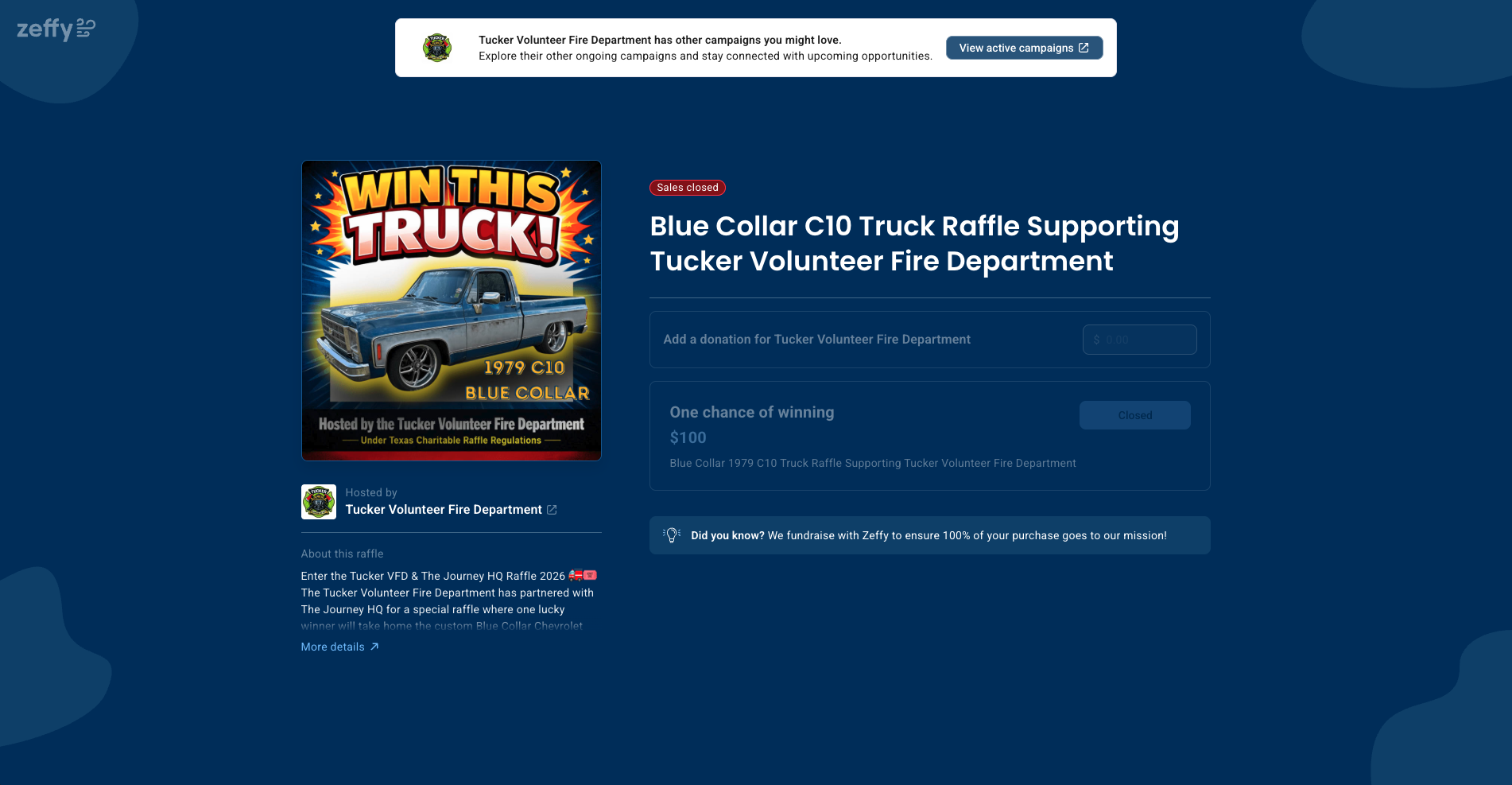
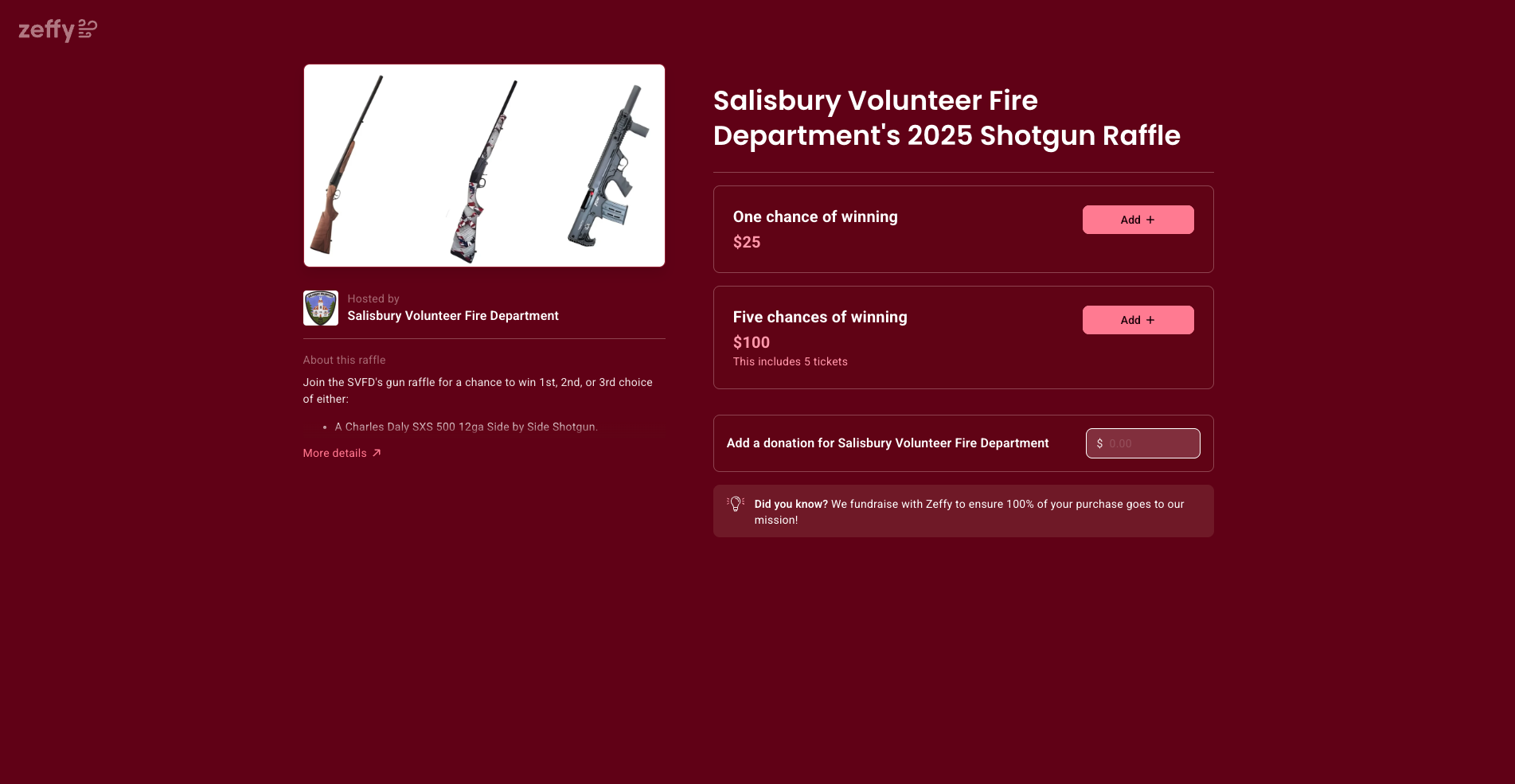
Startup cost: The prize, often donated. Revenue range: $1,000 to $10,000+ depending on the prize and your reach. Tip: A donated quarter side of beef, a Yeti cooler, or a guns-and-ammo basket consistently outperforms gift cards in small-town fire company raffles. Check your state raffle and lottery laws first. You can host a free online raffle (no fees on a single ticket) through Zeffy.
Fit: ✅ Realistic for a 5-volunteer crew.
Startup cost: $0. Revenue range: $500 to $5,000 per event. Tip: Pair it with another event you're already running, like a pancake breakfast or a soccer match, so you're not staffing two things. See our 50/50 raffle guide for the mechanics.
Fit: ✅ Realistic for a 5-volunteer crew.
For a small volunteer fire department: Start with a raffle. It's the lowest staffing load per dollar raised, and the prize is usually donated.
Bigger turnout, bigger revenue, more volunteers at check-in. These work, but only if you can actually staff them.
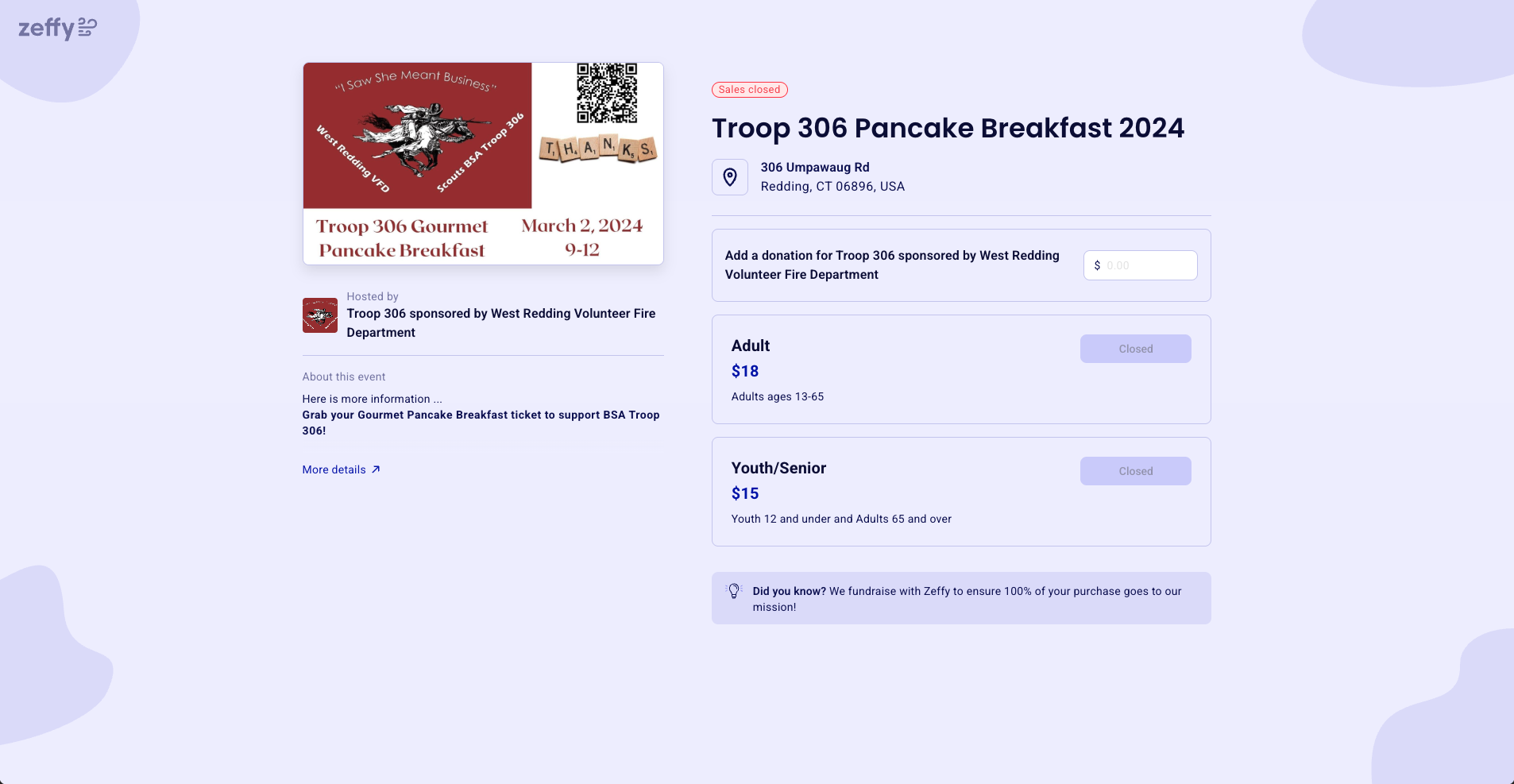
Attendance: 150 to 400. Revenue range: $1,500 to $6,000. Tip: Ask a local diner to donate batter and syrup. Sell tickets online ahead of time so the line at the door isn't where you collect cash. You can sell pancake breakfast and BBQ tickets online for free on Zeffy with QR check-in.
Fit: ⚠️ Needs 8 to 12 volunteers on event day.
Attendance: 200 to 500. Revenue range: $2,500 to $10,000. Tip: Drive-through pickup tickets are the secret. Same revenue, half the volunteer hours of a sit-down dinner.
Fit: ⚠️ Needs a pitmaster and 6+ volunteers.
Attendance: 100 to 300. Revenue range: $500 to $2,000 in donations, plus a recruiting boost. Tip: Run it during Fire Prevention Week in October. Set up a donation station with a tablet or phone for tap-to-pay so visitors can give without cash.
Fit: ✅ Realistic for a 5-volunteer crew.
Attendance: 75 to 200. Revenue range: $400 to $1,800. Tip: Add a raffle basket or 50/50 to layer a second revenue stream onto the same event.
Fit: ✅ Realistic for a 5-volunteer crew.
Attendance: 100 to 300. Revenue range: $600 to $2,500. Tip: A drive-in style movie night in the station parking lot needs almost no setup. Get the public-performance license before you advertise the title. Fit: ✅ Realistic for a 5-volunteer crew.
Attendance: 100 to 500. Revenue range: $3,000 to $15,000 with sponsorships. Tip: Sponsorship dollars are the real revenue. Registration fees barely cover t-shirts. Our 5K organizing guide walks the timeline.
Fit: ⚠️ Needs a dedicated event lead and 15+ volunteers.
Attendance: 100 to 250. Revenue range: $800 to $4,000. Tip: Firefighters vs. police is the classic, and the cross-promotion doubles your reach.
Fit: ⚠️ Needs an event lead.
Attendance: 60 to 150. Revenue range: $500 to $2,500. Tip: Tie it to International Firefighters Day on May 4 for built-in marketing.
Fit: ✅ Realistic for a 5-volunteer crew.
For a small volunteer fire department: One marquee community event per year is the right ceiling. Two is how volunteer crews burn out.
Online fundraising lets a small fire company reach donors who don't live within siren-range of the station. That's the whole point: a rural department of 800 households can pull in donations from former residents, family members, and seasonal visitors who'd never see a yard sign.
A note on cost. Typical total fees on most fundraising platforms (platform fee plus payment processing) run 2.2% to 3.5% per transaction for nonprofits, per Zeffy's analysis of nonprofit transaction fees. On a $50,000 year that's roughly $1,100 to $1,750 out the door before you count any monthly subscription. Zeffy is 100% free for nonprofits: no platform fee, no transaction fee, no credit card fee. Ever. You can see exactly how much other platforms cost your department with the fee calculator.
A campaign tied to one concrete thing (a thermal imaging camera, a new set of turnout gear, a defibrillator for the brush truck) raises more than a generic "support the department" ask. Show the price tag, show the gear, show the firefighter who'll use it.
Fit: ✅ Realistic for a 5-volunteer crew.
Every firefighter gets their own fundraising page and rallies their network. Stair-climbs, pledge drives, and "shave the chief" campaigns all run on this model. See our peer-to-peer fundraising page for setup.
Fit: ⚠️ Works when you have 10+ firefighters willing to share their page.
Always-on donations, not event-dependent. A modest base of 50 donors at $15/month is $9,000 a year that shows up even when you don't fundraise.
Fit: ✅ Realistic for a 5-volunteer crew.
Matching gift programs generate about $2.86 billion annually for nonprofits, per Double the Donation's matching gift statistics. A lot of that goes unclaimed because donors don't know their employer offers it. Add a one-line prompt on your donation form ("Does your employer match? Check here.") and you'll surface matches you'd otherwise leave on the table.
Fit: ✅ Realistic for a 5-volunteer crew.
For a small volunteer fire department: Online fundraising is the easiest cost-saver on this list. Move your raffle, ticket sales, and donation form to a free online fundraising platform and the fee savings alone usually fund a set of gear.
Many departments report donor fatigue and traffic-safety concerns with traditional fill-the-boot drives at intersections. The good news: the underlying idea (firefighters in uniform, in public, taking small donations) still works. You just don't need the boot or the intersection.
Set up a donation station inside or just outside the bay door. Use Tap to Pay on your iPhone instead of a boot at the intersection: no card reader, no cash, no cars-rolling-by liability. Most donors who used to drop a $5 in a boot will tap a $10 or $20 instead.
Fit: ✅ Realistic for a 5-volunteer crew.
Set up a table outside a local grocery store with the chief and one or two firefighters. Same uniformed-presence as a boot drive, off the road. Tap to Pay handles donations; pre-printed QR codes handle the rest.
Fit: ✅ Realistic for a 5-volunteer crew.
Pickup-only ticketed event in the station lot. Cars drive through, volunteers hand out boxes, no one stands in traffic. Sell tickets online ahead of time so check-in is a QR scan.
Fit: ⚠️ Needs a kitchen team.
A two-week digital campaign in October pegged to Fire Prevention Week. Email, social, a donate-now page on your site. Often outperforms a full Saturday on a curb.
Fit: ✅ Realistic for a 5-volunteer crew.
For a small volunteer fire department: Replace one boot drive this year with Tap to Pay at the station open house. Same uniform, same community moment, none of the road risk.
Merch works when you pre-sell to confirm demand and don't carry inventory. The fire company calendar is a classic for a reason, but it's not the only option.
Annual revenue range: $2,000 to $8,000. Find a local print shop, take photos at a single half-day shoot, pre-sell through your online store.
Fit: ⚠️ Needs someone to manage the photo shoot and print run.
Print-on-demand keeps inventory risk at zero. A clean department-logo tee with a slogan ("Engine 4. First in, last out.") sells year-round.
Fit: ✅ Realistic for a 5-volunteer crew.

Higher margin than t-shirts, popular with collectors and former first responders. Order in small batches.
Fit: ✅ Realistic for a 5-volunteer crew.
Partner with a local maker who shares revenue. "Firehouse" scents and pet-safe candles sell well at holiday markets.
Fit: ✅ if a local maker is on board.
You can run all of this through a free online store for nonprofits with no monthly fee and no per-sale cut. Pre-sales especially: collect the money first, place the print order second, avoid sitting on boxes of unsold hoodies.
For a small volunteer fire department: Pick one merch item and pre-sell it. Don't carry inventory and don't run three product lines at once.
One-off events spike. Recurring programs compound. A recurring base is what turns fundraising from a scramble into a budget.
Donors sponsor a named firefighter at $10, $25, or $50 a month. Funds go to gear, training, or a specific need. Recognition: name on a plaque inside the station, a quarterly email update from the firefighter they sponsor. You can set up a monthly Sponsor-a-Firefighter giving program in under an hour.
Fit: ✅ Realistic for a 5-volunteer crew.
Community members or local businesses sponsor the upkeep of a specific hydrant for a year. Tiered sponsorships ($50, $100, $500) cover paint, maintenance, and a small "sponsored by" plaque. Sell sponsorship spots as ticketed entries online so you have a clean record of who adopted which hydrant.
Fit: ✅ Realistic for a 5-volunteer crew.
Annual sponsorships from local businesses. Suggested levels: $250 Bronze (logo on website), $1,000 Silver (logo on department vehicles or banners), $5,000 Gold (named sponsor of an annual event).
Fit: ⚠️ Needs someone to actually go ask the businesses.
An end-of-year letter and email push to past donors. Low cost, high return on the donors who already know you.
Fit: ✅ Realistic for a 5-volunteer crew.
For a small volunteer fire department: One always-on recurring program (Sponsor-a-Firefighter is the cleanest) is the highest-leverage fundraiser on this list. Set it up once, promote it twice a year, let it run.
Rural fire company fundraising hits three constraints small-town departments and combined fire/EMS departments know well: a smaller donor base, fewer local businesses to sponsor events, and a geographic spread that makes turnout unpredictable. The fix is reach beyond the township line and partnerships with neighboring stations.
A high-prize raffle promoted online can pull tickets from across the county and beyond, not just your immediate community. Confirm your state raffle and lottery rules first; they vary widely.
Fit: ✅ Realistic for a 5-volunteer crew.
Two volunteer fire companies running one pancake breakfast pool their volunteer crews and their donor lists. Split the proceeds, double the staffing, half the burnout.
Fit: ⚠️ Needs coordination with the other chief.
People who grew up in the township and moved away often want to support the fire company they remember. A targeted Facebook campaign with a single donation link reaches them without any travel.
Fit: ✅ Realistic for a 5-volunteer crew.
Combine with neighboring fire, EMS, and police departments on a single calendar. Bigger print run, lower per-unit cost, broader audience.
Fit: ⚠️ Needs an event lead across departments.
A peer-to-peer style campaign where every active firefighter raises pledges from 10 households on their block. In a 1,200-household township, a 25-firefighter pledge drive can hit a lot of doors fast.
Fit: ⚠️ Requires firefighter buy-in.
For a small rural fire company: Your highest-leverage move is going online with a raffle or a recurring program. The donor pool inside the township is finite; the one outside it isn't.
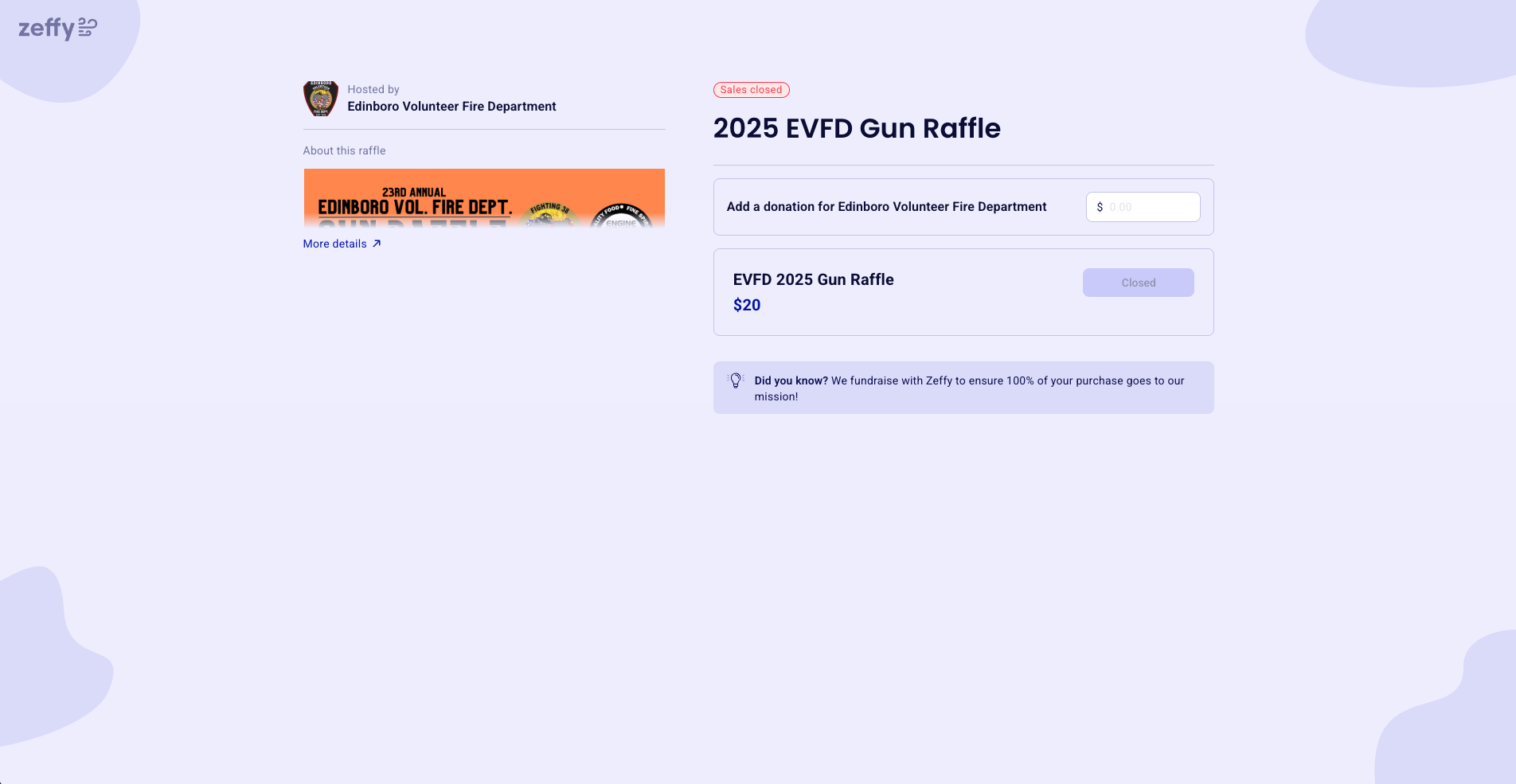
The Edinboro Volunteer Fire Department in Edinboro, Pennsylvania is a working example of a volunteer fire department running modern fundraising the right way. The department runs an annual gun raffle and accepts donations year-round through its public site, layering a recurring online ask on top of a marquee event. For volunteer fire departments wondering whether the online-plus-events combo actually works at small-town scale, Edinboro is a public, on-topic answer.
Most fundraising platforms take 5% to 10% of every dollar you raise. On a $50,000 fundraising year, that's roughly $2,500 leaving the station.
Here's what that $2,500 actually buys for a volunteer fire department:
Zeffy is 100% free for nonprofits: no platform fee, no transaction fee, no credit card fee. Ever. That $2,500 stays in the station. Run the numbers on the fee calculator with your own fundraising total.
100K+ nonprofits run on Zeffy, and they've collectively raised $2B+ at zero fees.
You don't need a six-month plan. You need to pick one thing and start.
For a small volunteer fire department: Start with one thing. A second fundraiser this year is a bonus, not the plan.
It depends on the event and your reach. A small bake sale or pizza night raises a few hundred to a couple thousand dollars. A well-promoted online raffle with a strong prize raises $1,000 to $10,000+. A community 5K with sponsorships can clear $15,000. A recurring Sponsor-a-Firefighter program with 50 monthly donors at $15 brings in $9,000 a year on autopilot.
An online raffle with a donated prize. Zero startup cost if the prize is donated, almost no volunteer hours on event day, and a much higher revenue ceiling than a bake sale. A monthly recurring giving program is the easiest always-on option.
Most fundraising platforms charge 2.2% to 3.5% per transaction in combined platform and payment processing fees. On a $50,000 fundraising year that's $1,100 to $1,750 leaving the department. Zeffy charges nonprofits no platform fee, transaction fee, or credit card fee of any kind, so every dollar donors give reaches the station.
You don't strictly need it to collect donations, but it matters for two things: donors can only claim a tax deduction if they give to a 501(c)(3), and most online fundraising platforms (including Zeffy) require 501(c)(3) status or equivalent to use the platform. Many volunteer fire departments fundraise through an affiliated nonprofit booster club or auxiliary that holds the 501(c)(3). Consult an attorney or CPA on your specific structure.
Yes, if the department itself has 501(c)(3) status, or if it fundraises through an affiliated nonprofit (a booster club, auxiliary, or relief association) that holds 501(c)(3) status. A lot of municipal volunteer fire departments use this second route already for their raffles and annual drives.
Yes. The fundraising ideas in this guide work the same for fire companies, EMS fundraising, and combined fire/EMS departments. The fit verdicts (✅ ⚠️ ❌) are based on volunteer crew size, not the type of service.


Discover our list of innovative fundraising ideas to raise more money. Explore unique and easy ideas for every organization.


Looking for effective online fundraising ideas without relying on in-person events ? Here are 2 online fundraisers ideas to start with.

Looking for the best ways to raise money for your school? Check out this list of 30+ top school fundraising ideas, ranging from easy to profitable.

.webp)


