We use cookies to improve your experience on our platform. By clicking “Accept all cookies”, you agree to the storing of cookies on your device to enhance site navigation, analyze site usage and assist in our marketing efforts.
Cookies required for basic website functionality.
Cookies used to deliver content most relevant to you and your needs.
Cookies used to deliver content most relevant to you and your needs.
Cookies that help understand the performance of the website, how users interact with it and to identify bugs.
How is Zeffy free?
How is Zeffy free?
Zeffy relies entirely on optional contributions from donors. At the payment confirmation step - we ask donors to leave an optional contribution to Zeffy.
13 Best Email Marketing Platforms for Nonprofits in 2026 (Free Options Included)
June 2, 2026
⚡TL;DR — The Short Answer
Verdict: For most small and mid-sized nonprofits, email belongs next to the donor record — not inside a marketer-grade platform billing you per contact. Zeffy is the only platform in this list that is 100% free at every scale.
What works: Zeffy (unlimited contacts, unlimited sends, built-in donor CRM, zero fees); Mailchimp and MailerLite for growing lists with a paid budget; ActiveCampaign for teams with a dedicated marketing staffer.
What doesn't: Marketer-grade free tiers are too small for most nonprofits. Nonprofit discounts are meaningful but they discount a curve that still rises with list growth.
Best for: Nonprofits under $5M revenue or fewer than 10,000 contacts who want one platform instead of five.
Worth considering if: You have a dedicated marketing staffer and a list size that justifies a per-contact bill — then Mailchimp, MailerLite, or ActiveCampaign earn their price curve.
If your nonprofit runs under roughly $5M in revenue or has fewer than 10,000 contacts, the "best email marketing platform" question is probably the wrong one to ask first. The real question is whether your email belongs inside a marketer-grade platform that bills you per contact, or next to the giving record in your donor CRM. This guide walks the 13 platforms most nonprofits compare in 2026, with verified discount notes where vendors publish them, and an honest split to help you avoid paying for capacity you will not use.
The honest split: donor-communication tool vs. marketer-grade platform
Most "best email marketing platform" roundups dodge the only question that matters for a nonprofit: is email a marketing channel you pay per contact for, or a donor-communication tool that lives next to the giving record?
Our take is that for the majority of small and mid-sized nonprofits, email belongs with the donor CRM. One platform instead of five. Unlimited contacts. Unlimited email sends. The marketer-grade platforms (Mailchimp, MailerLite, ActiveCampaign, HubSpot) are only worth their price curve once you have a dedicated marketing staffer and a list size that justifies the line item.
So before you pick a tool, decide which side of the split you are on:
Donor-communication tool: email tied to the donor record, segment by giving history, no per-contact bill. Right for nonprofits where the same person sends the appeal, thanks the donor, and pulls the report.
Marketer-grade platform: behavior-triggered workflows, journey builders, landing pages, deliverability tooling. Worth its price curve once you have dedicated marketing staff and a list that justifies it.
Quick comparison: best email marketing platforms for nonprofits
The table below summarizes the 13 platforms covered in this guide. The 5,000-contact annual cost column uses each vendor's published pricing for approximately 5,000 contacts at four sends per month, pre-discount unless noted; verify current figures on each vendor's pricing page before you commit, since email pricing changes often. Discount percentages are noted only where the vendor publishes them.
Platform
Free plan
Nonprofit discount
5,000-contact annual cost (pre-discount)
Deliverability note
Key limitation for nonprofits
Zeffy (our pick for donor-communication)
Yes, full product
100% free, always
$0
Standard shared sending
11,000-recipient cap per blast; no behavior-triggered automation
MailerLite
Yes, up to 1,000 contacts / 12,000 sends per month
See mailerlite.com/pricing for current nonprofit terms
~$432/yr (Growing Business plan at ~$36/mo for 5K contacts; verify at mailerlite.com/pricing)
Strong reputation
Per-contact pricing scales on paid tiers
Mailchimp
Yes (500 contacts / 1,000 sends per month — verify current limit at mailchimp.com/pricing)
15% on paid plans for verified nonprofits
~$540/yr (Essentials at ~$45/mo for 5K contacts; verify at mailchimp.com/pricing)
Strong reputation
Costs jump sharply with list growth
Constant Contact
30-day trial only
20–30% off paid plans, scaled by account tenure
~$600/yr (Standard plan; verify at constantcontact.com/pricing)
Strong reputation
No permanent free plan
ActiveCampaign
14-day trial only
20% off for verified nonprofits
~$948/yr (Starter plan at ~$79/mo for 5K contacts; verify at activecampaign.com/pricing)
Strong reputation
Overkill without a dedicated marketing staffer
Brevo
Yes, capped by daily send volume (300 emails/day on free tier)
15% off paid plans
~$228/yr (Starter plan; contact-unlimited but send-volume-based; verify at brevo.com/pricing)
Standard
Free tier capped by daily send volume
GetResponse
30-day trial only
50% off via TechSoup — verify current terms at techsoup.org and getresponse.com
~$564/yr (Email Marketing plan at ~$47/mo for 5K contacts; verify at getresponse.com/pricing)
Standard
Webinar-heavy feature set you may not use
HubSpot
Free CRM tier (limited sends)
Nonprofit discount on Marketing Hub — see hubspot.com/nonprofits for current terms
Starts ~$1,800/yr (Starter Marketing Hub; rises sharply at Professional/Enterprise; verify at hubspot.com/pricing)
Strong reputation
Enterprise-level; overkill for small nonprofits
AWeber
Yes, up to 500 subscribers
501(c)(3) discount available — see aweber.com/pricing for current terms
~$228/yr (Pro plan at ~$19/mo for up to 500; scales to ~$46/mo for 5K contacts; verify at aweber.com/pricing)
Standard
Aging interface; weaker segmentation
Campaign Monitor
Yes, limited (preview only without paid plan for full sends)
15% off paid plans
~$612/yr (Basic plan at ~$51/mo for 5K contacts; verify at campaignmonitor.com/pricing)
Strong reputation
Strong analytics, fewer nonprofit-specific features
Flodesk
30-day trial only
None published
~$348/yr (flat-rate plan; verify current pricing at flodesk.com/pricing — pricing model has shifted)
Standard
Flat-rate model has changed; confirm current plan before signing up
Benchmark Email
Yes, limited (up to 500 contacts / 3,500 sends per month)
25% off for registered nonprofits
~$480/yr (Pro plan at ~$40/mo for 5K contacts; verify at benchmarkemail.com/pricing)
Standard
Lighter automation than ActiveCampaign or Mailchimp
Emma
No
No published nonprofit discount — contact Emma directly
Mid-market pricing; no self-serve pricing page — contact Emma for a quote
Strong reputation
No free plan; priced for mid-market teams
Our pick: Zeffy for nonprofits that want one platform instead of five and zero per-contact bills.
Why nonprofits use email marketing software
Email marketing software is a cost-effective way to engage supporters and drive mission impact. Here is why it matters:
Personalized communication: Segment your audience and tailor messages to specific donor groups, increasing relevance and engagement.
Automation: Save time with automated workflows for welcome series, donation thank-yous, and event reminders.
Data-driven decisions: Gain insights into open rates, click-throughs, and conversions to refine your strategy.
Cost-effectiveness: Reach a wide audience at a fraction of the cost of traditional marketing methods.
Increased donations: Send targeted appeals and showcase impact stories to encourage giving.
Volunteer engagement: Keep volunteers informed and engaged with regular updates and opportunities.
Brand consistency: Maintain a professional look with customizable templates that align with your nonprofit's branding.
By leveraging email marketing software, nonprofits can build stronger relationships, streamline operations, and ultimately make a greater impact in their communities.
Zeffy is a 100% free fundraising platform with built-in email marketing that lives next to the donor record. 100K+ nonprofits use Zeffy, and they have raised $2B+ in donations. No platform fees, no transaction fees, no credit card fees. Ever. Your nonprofit keeps 100% of every donation, no matter what.
Because Zeffy combines email, donor management, ticketing, and donation forms in one platform, you get one platform instead of five. Email lives next to the giving record, which means every open, click, and donation auto-appends to the contact in your donor list.
"I found Zeffy's system for managing donor contacts and sending targeted emails incredibly easy to use. The ability to track whether recipients opened emails or responded to reminders allowed me to engage with donors more effectively. It gave me insights into their activity, which helped optimize our outreach and maintain strong communication throughout the campaign." Uriel Ramirez, Founder - Pan-American Medical Association
What Zeffy email actually does
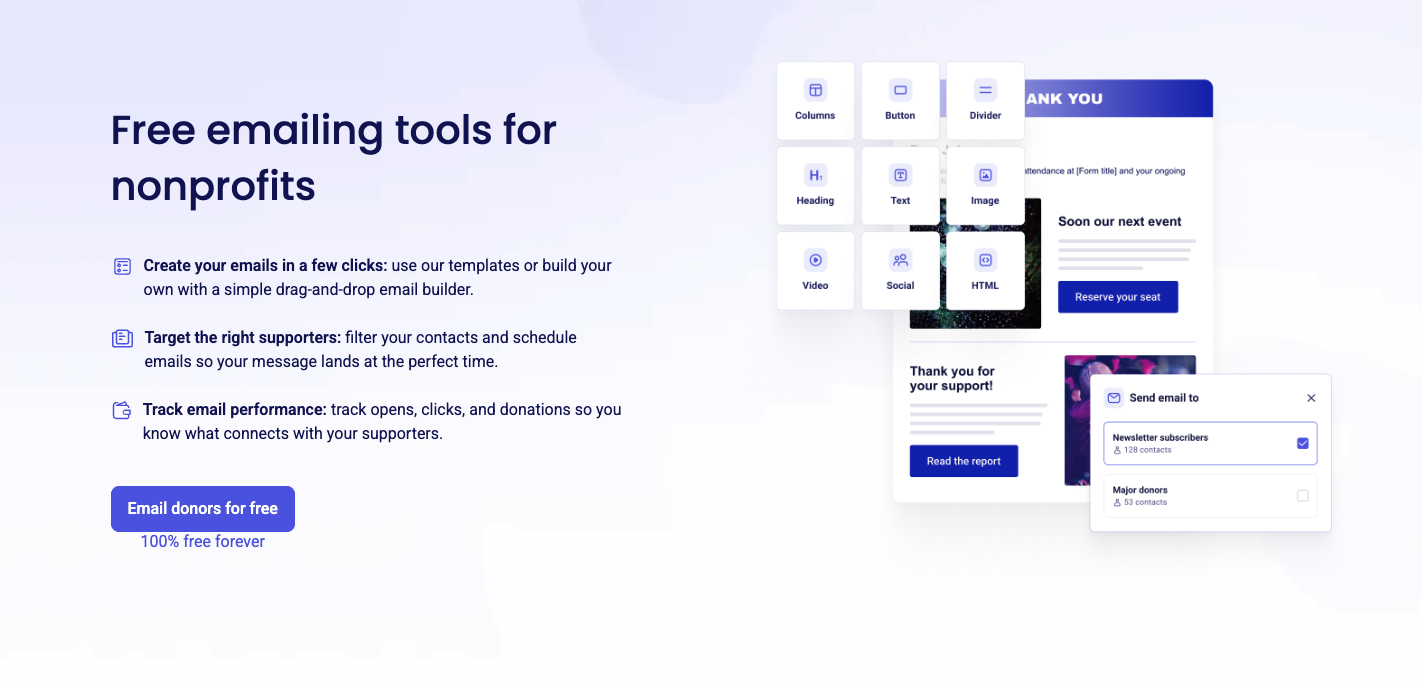
Drag-and-drop email builder with ready-to-use templates
Unlimited contacts and unlimited email sends (with an 11,000-recipient cap per individual blast)
Auto-filtering contact lists by donation history, campaign, or giving history
Embeddable signup forms that sync to your email lists
Open, click, and donation tracking automatically appended to donor records
Direct Mailchimp contact import via connector or CSV
Scheduled sends
Built-in donor CRM that emails are tied to (segment, tag, filter)
Automated reminder emails from the donor record
Pre-filled donation forms you can link directly from any email
“Having our donor emails from a fundraising campaign is a game changer. We can then send newsletters to our greatest supporters, which helps us keep growing with volunteers, donations and important connections.” Ranna Salem, Founder - Nineveh Rising
2. MailerLite: strong deliverability, but the price curve rises fast
MailerLite has a clean drag-and-drop builder, signup forms, and segmentation logic that lets you stack multiple conditions to target an email list. It is a common stepping-stone for nonprofits that have outgrown Gmail blasts but are not ready for a marketer-grade platform. The free plan covers up to 1,000 contacts and 12,000 sends per month — generous enough to get started, but the price curve rises once you cross that threshold.
Best features
Visual automation builder
Customizable signup forms and landing pages
Targeted campaign segmentation
Workflow automation
Reporting dashboard
Pricing
MailerLite offers a free plan (up to 1,000 contacts / 12,000 sends per month) and paid tiers (Growing Business, Advanced, Enterprise) that scale with contact count. For current nonprofit pricing, see mailerlite.com/pricing.
3. Mailchimp: the most recognizable name, but watch the cost curve
Mailchimp is the platform most nonprofits know by name. It has 50+ behavior-based triggers, an AI assistant for drafting copy, segmentation, and click-map reporting. It is also where most "I am paying too much for email" stories start, because the price curve gets steep as your contact list grows.
Best features
Multiple list segmentation options
Email preview tool
Pre-built autoresponder templates
AI assistant for email copywriting
Delivery by recipient's time zone
Pricing
Mailchimp's free tier covers up to 500 contacts and 1,000 sends per month — verify the current limit at mailchimp.com/pricing before you rely on it, as Mailchimp has adjusted these figures in the past. Paid plans (Essentials, Standard, Premium) scale by contact count. Mailchimp publishes a 15% discount for verified nonprofits on paid plans; the free tier itself does not change.
4. Constant Contact: phone support sets it apart, but there is no free plan
Constant Contact is the longest-running email service in this list and is best known for responsive customer support, including phone support that smaller vendors do not offer. It is also useful for event-driven nonprofits because it pairs email with event registration and landing pages.
Best features
Drag-and-drop email builder
Thousands of integrations including Zapier, Salesforce, and Eventbrite
Signup forms and landing pages
Email heat map showing most-clicked links
Customer list management
Pricing
Constant Contact offers a 30-day free trial and three paid plans (Lite, Standard, Premium). Nonprofit discounts range from 20% to 30% on paid plans, scaled by account tenure. No permanent free plan exists.
5. ActiveCampaign: serious automation power for teams ready to use it
ActiveCampaign is built for organizations that need real automation, not just scheduled sends. Hundreds of pre-built automation templates cover welcome series, drip campaigns, event follow-ups, and renewal nudges. Predictive and conditional content uses machine-learning logic to recommend the best variation per contact.
This is a marketer-grade platform. It is worth its price curve once you have a dedicated marketing staffer who can build and maintain the workflows. For most small nonprofits, it is overkill.
Best features
Tag-based sorting, sending, and automation
Ready-made automation templates
Visual automation builder
Conditional content display
Smart list segmentation
Pricing
A 14-day free trial and four paid tiers (Starter, Plus, Pro, Enterprise). ActiveCampaign publishes a 20% discount for nonprofits. Verify current pricing at activecampaign.com/pricing.
6. Brevo: high send volume on a tight budget
Brevo is positioned for organizations sending a lot of mail on a tight budget. The interface is clean, and the platform handles email plus SMS sequences in one tool. Scheduled sends include send-time optimization per recipient. The free plan allows up to 300 emails per day, but that daily cap is the defining constraint — plan your send schedule around it before you commit.
Best features
Advanced segmentation and automation
Drag-and-drop email builder
In-built CRM
Signup forms and landing pages
Send-time optimization
Pricing
Brevo's free plan allows unlimited contacts but caps at 300 emails per day. Paid plans (Starter, Business, Enterprise) are priced by monthly send volume rather than contact count — a structural advantage for nonprofits with large but infrequently-emailed lists. Nonprofits get 15% off paid plans. Verify the current daily-send cap and paid-plan rates at brevo.com/pricing.
7. GetResponse: built-in webinar hosting makes it a niche pick
GetResponse stands out for A/B testing across more than just subject lines and CTAs (you can compare entire campaign variations) and for built-in webinar hosting, which other platforms in this list do not include.
Best features
AI email template generator
Popups and landing pages
Email automation
SMS marketing
Built-in webinar hosting
Pricing
A 30-day free trial with paid plans (Email Marketing, Marketing Automation, E-commerce Marketing). GetResponse has historically offered a 50% discount to nonprofits via TechSoup; verify current discount terms at both techsoup.org and getresponse.com before purchase, as TechSoup program terms change periodically.
8. HubSpot: enterprise-grade CRM pairing for major-gift teams
HubSpot pairs email with a full CRM, marketing automation, and sales tooling. With donor details like contact name, lifecycle stage, and engagement history flowing into the CRM, you can build email content that is highly targeted.
This is enterprise-level software and overkill for small nonprofits. It earns its keep at organizations with sales-style donor pipelines, major-gift teams, or multi-channel campaigns that need a single source of truth.
Best features
AI-generated subject lines and email copy
Extensive segmentation
Goal-based email templates
Omnichannel marketing automation
Detailed reporting and analytics
Pricing
HubSpot offers a free CRM tier with limited email sends. Marketing Hub paid plans start at a per-seat rate for small teams and rise sharply for Professional and Enterprise tiers. HubSpot has published a nonprofit discount on Marketing Hub; see hubspot.com/nonprofits for current terms.
AWeber. A beginner-friendly platform with drag-and-drop editing, a link-review tool that catches broken links, and a mobile editor. The free plan covers up to 500 subscribers. AWeber offers a 501(c)(3) discount; see aweber.com/pricing for current terms and eligibility requirements.
Campaign Monitor. Known for strong analytics, pre-send spam testing, and professionally designed templates. A free plan exists for very small lists. Nonprofits get 15% off paid plans.
Flodesk. Best known for visually polished templates, useful for nonprofits without a designer on staff. Historically offered a flat-rate plan for unlimited subscribers; the pricing model has shifted, so see flodesk.com/pricing for current plans before signing up.
Benchmark Email. Strong on autoresponder templates and step-by-step sequence building, with surveys, A/B testing, and Salesforce/WordPress integrations. The free plan covers up to 500 contacts and 3,500 sends per month. Offers a 25% discount to registered nonprofits.
Emma. Built for mid-market teams that need brand-locked templates shared across departments. No free plan. Pricing is set at the mid-market tier with custom enterprise options; contact Emma directly for a quote.
What to look for in nonprofit email marketing software
List segmentation
Segmentation is what turns a list into a strategy. Look for a tool that lets you:
Group contacts by donor status, engagement level, or interest
Tailor messages to specific audience segments
Improve relevance and engagement rates
Personalize content for different supporter groups
Optimize campaign performance through targeted messaging
Aim for segments that meaningfully impact your strategy. Too many segments fragments your audience; too few produces generic mail.
Email automation
Automated workflows save time and keep donors warm without manual lift. Look for support for:
Welcome series for new subscribers
Donor appreciation sequences
Event registration and follow-up
Membership renewal nudges
Volunteer signup and engagement
Templates and a drag-and-drop editor
A diverse library of customizable, mobile-responsive templates and an intuitive drag-and-drop editor will save your team hours per week. Bonus points for saving custom templates you can reuse.
A/B testing and reporting
Prioritize platforms with an analytics dashboard you can actually read. Track opens, clicks, bounces, and spam reports at a minimum. A/B testing on subject lines, CTAs, or full campaign variations lets you do the math out loud on what is working.
Email deliverability
Look for platforms with email authentication protocols (SPF, DKIM, DMARC), reputation management, and list-cleaning features. Spam testing before send is a quiet workhorse that protects sender reputation.
Integrations
Your email tool should integrate with your donor CRM, donation platform, event management, and analytics. Or, you can use a platform like Zeffy where those are already one product.
Hidden costs to watch
Three line items quietly inflate your nonprofit email bill:
Per-contact pricing. List growth raises your bill on most paid platforms, often by a step function at contact-tier breakpoints.
Features locked behind higher tiers. Segmentation, automation, A/B testing, and priority support are commonly held above the entry tier.
Per-email send caps and overage fees. Some platforms charge once you exceed monthly send volume; others throttle you.
Free plans vs. nonprofit discounts: what is actually worth it?
Free plans on marketer-grade platforms are a foot in the door, not a destination. Most cap contacts in the low hundreds to low thousands, throttle sends, or hide segmentation behind a paywall.
A useful rule of thumb:
If you have fewer than 500 contacts and send fewer than 2,000 emails per month, marketer-grade free plans can work for the first season.
Above that, do the math out loud. Calculate your annual cost at your projected list size 12 months from now, not today. The 5,000-contact annual cost column in the table above is the right starting point for that calculation.
Nonprofit discounts (15–50%) are meaningful but they discount a curve that still rises with list growth. A 30% discount on a $600 annual bill is still $420 per year — and that bill doubles when your list doubles.
Zeffy stays free at every scale. Unlimited contacts. Unlimited email sends. No platform fees, no transaction fees, no credit card fees. Ever.
How to switch email platforms without losing subscribers
Migration mechanics matter more than most platforms admit. A bad cutover can damage your deliverability reputation for months. Here is the short version:
1.Export your full list. Pull contacts, segmentation tags, custom fields, and unsubscribe records from your current tool. Unsubscribes are not optional; importing a person who opted out is a deliverability and compliance hit.
2.Warm the new sending domain. If your new platform uses shared sending, start with smaller, highly engaged segments before broadcasting to the full list.
3.Re-confirm consent where required. If you are crossing jurisdictions or your old consent records are thin, a re-confirmation campaign is cheaper than a sender-reputation rebuild.
4.Run both platforms in parallel for one cycle. Send a low-stakes campaign on the new tool before retiring the old one.
5.Update embedded signup forms last. Anywhere your old signup form is embedded — website, footer, social bios — should switch to the new tool's form once you have confirmed it syncs correctly.
If you are migrating from Mailchimp specifically, Zeffy supports direct Mailchimp contact import. See the Zeffy emailing migration guide for the connector and CSV options.
Final thoughts on choosing the best email marketing software for nonprofits
Start with the honest split. If your email is fundamentally donor communication that should live next to the giving record, Zeffy gives you the full stack for free. If you have a dedicated marketing staffer and a list size that justifies the line item, a marketer-grade platform like Mailchimp, MailerLite, or ActiveCampaign earns its price curve.
Either way, do the math out loud at the list size you expect in 12 months, not the list size you have today. That is where most nonprofit email bills quietly double.
For nonprofits that want email tied to a donor CRM with unlimited contacts and unlimited sends, Zeffy is the only platform that is 100% free at every scale. For nonprofits that need behavior-triggered automation, journey builders, or webinar hosting, marketer-grade platforms (Mailchimp, MailerLite, ActiveCampaign, Brevo, GetResponse) offer limited free tiers, but the price curve rises with list size.
Yes. Mailchimp publishes 15% off paid plans for verified nonprofits. Constant Contact offers 20–30% off, scaled by tenure. ActiveCampaign offers 20%. Brevo and Campaign Monitor offer 15%. Benchmark Email offers 25%. GetResponse has historically offered a 50% discount via TechSoup — verify current terms at techsoup.org. AWeber offers a 501(c)(3) discount; see aweber.com/pricing for current terms. HubSpot has published a nonprofit discount on Marketing Hub; see hubspot.com/nonprofits for current terms. Zeffy is 100% free without any discount application.
Most nonprofits land between two and six newsletter or appeal sends per month, plus automated transactional emails (donation receipts, event confirmations, thank-yous). Send cadence matters less than relevance: segment your list so each contact receives mail that matches their giving history and stated interests.
Gmail is fine for one-to-one donor communication and small board updates. It is not built for list email. Google's sending limits, lack of unsubscribe handling, and absence of analytics make Gmail blasts a deliverability and compliance risk once your list grows beyond a few dozen contacts. Move to a dedicated platform before you scale.
Nonprofit open rates tend to run higher than commercial averages, especially for engaged donor lists and event-driven sends. Rather than chasing a single benchmark number, track your own historical performance and segment-level data over time — that internal trend is more actionable than any industry average. The M+R Benchmarks report, published annually at mrbenchmarks.com, is a widely used directional reference for the nonprofit sector.
Add a signup form to your website and event landing pages, collect emails at every in-person event, run referral campaigns to existing subscribers, and use social channels to drive list signups. Tie every donation form to your email list so first-time donors land in your CRM automatically.
Email Marketing for Nonprofits - Top Tools and Best Practices in 2024
Email marketing for nonprofits can help you increase donations, share your mission, and engage with supporters. Explore best practices and top tools to for successful email campaigns.
Look for people who attend related events, follow relevant Facebook groups, or subscribe to aligned newsletters.These aren’t just potential donors—they’re your future advocates.
Look for people who attend related events, follow relevant Facebook groups, or subscribe to aligned newsletters.These aren’t just potential donors—they’re your future advocates.






.webp)

