We use cookies to improve your experience on our platform. By clicking “Accept all cookies”, you agree to the storing of cookies on your device to enhance site navigation, analyze site usage and assist in our marketing efforts.
Cookies required for basic website functionality.
Cookies used to deliver content most relevant to you and your needs.
Cookies used to deliver content most relevant to you and your needs.
Cookies that help understand the performance of the website, how users interact with it and to identify bugs.
How is Zeffy free?
How is Zeffy free?
Zeffy relies entirely on optional contributions from donors. At the payment confirmation step - we ask donors to leave an optional contribution to Zeffy.
Are Raffles Legal in Colorado? Nonprofit Licensing Guide (2026)
August 4, 2026
⚡TL;DR — The Short Answer
Verdict: Raffles are legal in Colorado for qualified nonprofits that have operated 5+ years and hold a Bingo-Raffle license from the Colorado Secretary of State. Selling the tickets online is allowed too, but on a banking condition the state words very precisely: proceeds must go directly into your dedicated bingo-raffle account, and payment processing cannot run through any other account and then get transferred in. Do not assume any platform satisfies that, Zeffy included: confirm your payment flow with the Secretary of State before you sell online.
What works: Applying early, designating a certified Games Manager, submitting your voided sample ticket on time, keeping sales inside Colorado, and depositing every dollar into your dedicated bingo-raffle account.
What doesn't: Assuming a new nonprofit qualifies. The five-year continuous-operation rule catches most newer 501(c)(3)s before they even apply.
Best for: Colorado nonprofits with 5+ years of continuous operation, a Games Manager, and a prize pool big enough to clear the licensing and quarterly-reporting load.
Worth considering if: You expect ticket sales above ~$5,000. Under that, the compliance overhead usually eats the upside. Run a donation drive or ticketed event instead.
Quick answer: Are raffles legal in Colorado?
Yes, but only for qualified nonprofits. To run a raffle in Colorado you must be a nonprofit that has been in existence in the state for five or more years, hold a Bingo-Raffle license from the Colorado Secretary of State, and route every dollar of raffle proceeds directly into a dedicated bingo-raffle account. Individuals and for-profit businesses cannot hold a raffle, and newer nonprofits are not eligible until they cross the five-year mark.
A raffle can turn a simple interactive game into a real fundraising win, but Colorado is one of the stricter states about who runs one and how. This guide walks through eligibility, licensing, ticket rules, online sales, and taxes in plain English so you know what to confirm before you sell a single ticket. See also our raffle laws by state overview if you fundraise across state lines.
Is a licensed raffle right for your nonprofit?
Before you invest a month in paperwork, be honest about two things.
1. Are you actually eligible? Two hard filters kill most small orgs before they start:
The five-year continuous-operation rule. If your nonprofit was incorporated fewer than five years ago, you cannot get a Bingo-Raffle license in Colorado. Full stop.
The dedicated bingo-raffle account rule. Every dollar of raffle revenue has to land in that account first, not your general operating account and not a platform's holding account.
2. Is the compliance load worth the money you'll raise? For a Colorado nonprofit with five or more years of history, a certified Games Manager, and expected ticket sales above roughly $5,000, a licensed raffle is usually worth it. The mechanics are cheap and the audience response is strong. For a first raffle expected to raise less than a few thousand dollars, the license fee, Games Manager training, voided-ticket submission, and quarterly reporting eat the upside.
For a small nonprofit: if you fail either filter, skip the raffle. Run a free donation form, a peer-to-peer campaign, or a paid-ticket event instead. Same audience, no Bingo-Raffles Division paperwork.
Colorado raffle law: what the statutes actually say
Colorado's raffle rules live in Title 24, Article 21, Part 6 of the Colorado Revised Statutes, plus the administrative rules at 8 CCR 1505-2. These are the primary legal authorities. You can read the current bingo-raffle rules on the Colorado Secretary of State's Bingo and Raffles site. Confirm every specific section number and threshold against the primary source at leg.colorado.gov before relying on any figure — the statute is amended periodically and the current published version controls.
How Colorado defines a raffle
Under Colorado law, a raffle is a game in which a participant buys a ticket for a chance at a prize, with the winner determined by a random method set by the licensing authority, or a pull tab ticket. If your event uses skill, strategy, or variable ticket pricing that changes the odds of winning, it may not qualify as a raffle at all and could fall under different rules entirely. Confirm your specific event format with the Bingo and Raffles Division before selling tickets.
Who counts as a qualified organization
Only qualified nonprofit organizations may conduct raffles. Per the Colorado Secretary of State's Bingo-Raffles FAQ, an organization must have been in existence in Colorado for five or more years to be eligible for a Bingo-Raffle license. Your org must also operate for a charitable, religious, educational, civic, fraternal, or similar purpose and use net raffle proceeds for that stated purpose, not for private gain.
The licensing requirement
Colorado's Secretary of State FAQ is unambiguous: a license is required for any raffle. Confirm with the Bingo and Raffles Division (licensing@coloradosos.gov) whether any dollar-based thresholds or exemptions apply to your specific situation under the current statute before assuming one applies or does not apply.
Prize and proceeds restrictions
Colorado law limits how proceeds may be used. Net proceeds must go to the charitable purpose stated on your license application. Under the bingo-raffle rules, no one may receive remuneration, commission, salary, or compensation for participating in the management or operation of a bingo-raffle game. Volunteers cannot be reimbursed even for buying supplies, and volunteer meals are subject to a per-person per-shift cap under the administrative rules. Confirm the current figures in the published 8 CCR 1505-2 rules on the Secretary of State's site.
For a small nonprofit: the statute isn't the hard part. The hard part is the operational discipline it forces: a separate account, unpaid volunteers only, meticulous records. Read Part 6 once, then translate it into a one-page checklist your board and Games Manager can actually follow.
Who can legally run a raffle in Colorado
To be eligible for a Bingo-Raffle license, your organization must:
Be a bona fide religious, charitable, labor, fraternal, educational, voluntary firemen's, or veterans organization
Have a nonprofit national or state organization, or bona fide chartered branch, based in Colorado
Operate without profit
Have been in existence in Colorado for five or more years, continuously, with an engaged membership the entire time
Have at least one member currently certified, or set to be designated, as Games Manager when the license is issued
See the Colorado Secretary of State's Planning a Raffle guide for the official eligibility documentation.
Who cannot run a raffle in Colorado
Colorado law is clear: only qualified nonprofit organizations may conduct raffles. Individuals, for-profit businesses, and newly formed nonprofits that have not yet met the five-year requirement are all prohibited, even if the proceeds are intended for charity. Good intentions do not substitute for a license.
Running an unlicensed raffle isn't just a technical issue. Under House Bill 24-1326, the Secretary of State's fining authority increased, with a maximum fine of $250 per violation and the removal of the "fine in lieu of suspension" option. That adds up fast if you sell hundreds of tickets before anyone catches the problem.
For-profit businesses sometimes float "charity raffle" promotions. Under Colorado law this is not permitted unless a separately qualified nonprofit holds the license and controls the proceeds. A business cannot designate a charity as a beneficiary and then run the raffle itself. And if someone asks to "borrow" your license number for their event, say no. Lending a license puts your organization's status at risk.
For a small nonprofit: if you're under five years old, no workaround exists. Don't try to co-run with an older nonprofit unless they truly hold the license and control every dollar. It's not worth the audit risk.
Tax implications of raffle winnings in Colorado
Winning a raffle prize feels great until tax season. Both your organization and your winners have obligations worth understanding before you launch.
Federal reporting: IRS Form W-2G
Raffle prizes are treated as gambling winnings by the IRS. If a winner receives a prize worth $600 or more and the prize is at least 300 times the ticket price, your nonprofit must issue IRS Form W-2G to the winner and file a copy with the IRS. For prizes valued at more than $5,000 (net of the wager), 24% federal income tax withholding generally applies before the prize is distributed.
The operative form for raffle winnings is W-2G, not 1099. If you're offering a high-value prize like a car or a large cash equivalent, build the W-2G workflow into your post-raffle plan. Missing required forms can create IRS penalties for your organization.
Colorado state income tax on prizes
Colorado taxes gambling and raffle winnings as ordinary income. Winners include the fair market value of their prize on their Colorado individual income tax return. Per the Colorado Department of Revenue individual income tax guide, gambling winnings over $5,000 are subject to Colorado income tax withholding at 4%.
Your nonprofit isn't responsible for calculating a winner's personal state tax bill, but a short note in your winner notification explaining that prizes may be taxable is smart practice.
What your nonprofit owes
Raffle proceeds themselves are generally not taxable to your nonprofit as long as they support your exempt purpose. Proceeds used outside your stated mission could raise Unrelated Business Income Tax (UBIT) questions. Keep raffle proceeds designated and documented. Consult a tax professional before your first large raffle, especially if prize values are significant.
For a small nonprofit: the tax layer is where a lot of first-time raffle organizers get burned. If your prize is worth $600 or more and at least 300 times the ticket price, you owe a W-2G. Bookmark that rule and put a reminder on the day of the drawing.
How to apply for a Bingo-Raffle license: step-by-step
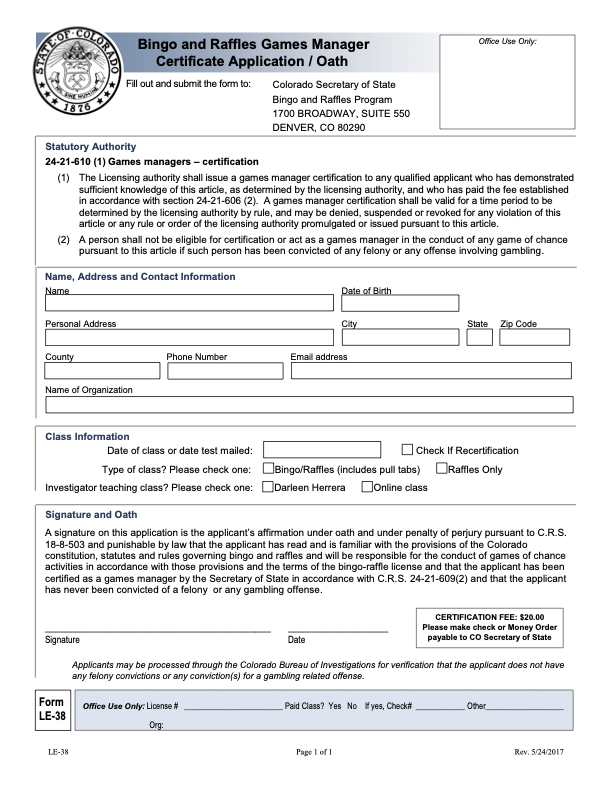
1. Complete the Bingo and Raffles Games Manager Certificate Application
Start with the official application form from the Colorado Secretary of State. Match your organization's name, address, and key details exactly to your official records. Mismatches delay approval.
2. Gather key documents
Have everything ready to upload as .jpg, .gif, .png, .tif, or PDF files. According to the Colorado General Assembly, you'll need:
Proof of five years of continuous existence (incorporation certificate or tax filings)
Organization's purpose and membership qualifications
Copies of articles, by-laws, and membership roster
Names and addresses of board members
3. Designate your Games Manager
You must assign a certified Games Manager who has completed the state's training program. See the Games Manager training page for fees and schedule. The test is open book, certificates typically arrive within 10 business days, and certification is valid for 4 years.
How to choose a Games Manager:
Confirm credentials: pick someone who understands Colorado's specific rules, not just general raffle experience.
Prioritize compliance mindset: the Games Manager owns your quarterly reporting.
Ask for referrals: other qualified organizations often know good managers.
Look for clear communication: this person handles money and paperwork on your behalf.
4. Submit your application with the required fee
File online, or mail to:
Colorado Department of State, Bingo and Raffles
1700 Broadway, Suite 550
Denver, CO 80290
The application fee is $100, payable by credit card or check. Online payments are faster and give instant confirmation. Approval can take up to six weeks.
For a small nonprofit: six weeks is real. If your fundraising event has a fixed date, start the license process at least three months out, not three weeks.
Requirements to host a raffle in Colorado
Voided sample ticket submission
Colorado does not limit the number of raffles you can hold while your license is active. But if the retail value of all prizes exceeds $1,000, you must submit a voided printed ticket to the Secretary of State before ticket sales begin. Non-web submissions take five to seven working days to review, so plan accordingly.
Submission methods:
Email: licensing@coloradosos.gov
Fax: 303-869-4871
Mail or in-person: Colorado Department of State, Bingo and Raffles, 1700 Broadway, Suite 550, Denver, CO 80290
The current 8 CCR 1505-2 rules cover the full ticket-submission procedure.
Raffle ticket requirements
Include these details on every ticket:
Raffles with prizes under $1,000
Raffles with prizes over $1,000
Space for the ticket holder's name and address
Your license number
Web address where winning numbers will be posted
Nonprofit name as it appears on your license
Timeframe for posting the winning number
Date, time, and location of the draw
Phone number to verify the winning number
Ticket price
Major prize description
Dates of any ticket price changes
Unique ticket number (recommended for tracking)
Fees
One-time raffle fees
Quarterly fees on gross proceeds
Bingo-Raffle license: $100
Raffles under $5,000: no fee
Games Manager certificate: $20 in-person, free online
Raffles between $5,000 and $100,000: 0.45% to 0.5% of proceeds
Colorado permits card payment for a raffle ticket outright. Rule 4.1.1(a) of 8 CCR 1505-2 requires a licensee to collect the consideration for playing a game of chance "in full, in advance, by check, cash, or debit or credit card", so you can sell raffle tickets in person with Tap to Pay at the door and take a card for them.
The condition is where the money lands, and it is strict. The same rule requires you to "directly deposit all proceeds into the licensee's segregated checking or savings account" and says you "may not commingle proceeds with funds in a general account or other account". C.R.S. 24-21-622(3)(a) names raffles expressly. Confirm with the Bingo and Raffles Division (licensing@coloradosos.gov) that your payment flow satisfies that before you sell.
Recordkeeping
For every ticket sold, record buyer name, Colorado address, payment method, ticket number, and drawing result. Colorado requires that you keep raffle ticket stubs and unsold tickets for six months following the quarter in which the raffle was held, and all other required records for two years. A donor CRM that lets you manage ticket buyers and email participants makes the audit trail automatic instead of a spreadsheet nightmare.
Notifying winners
In-person drawing: allow 30 minutes for the winner to claim the prize. If unclaimed, continue drawing until someone claims it.
Mail notification: send certified mail within 30 days of the drawing, including the prize, contact number, and claim details.
Online notification: post winning ticket numbers and a contact number on your website within 24 hours of the drawing and keep it up for at least 30 days.
Post-raffle reporting
After your raffle, file a quarterly report covering receipts, expenses, and how funds were used. Even a quarter with no sales requires a "No Activity" report. Fees on gross receipts are due at filing. Reports are due on the last day of the month following the end of each calendar quarter. File through your Colorado Bingo-Raffle account. Questions go to the Bingo and Raffles program at 303-869-4910 or licensing@coloradosos.gov.
For a small nonprofit: the quarterly report is where most orgs slip. Put the four filing deadlines on the calendar the day your license is approved.
Selling raffle tickets online in Colorado
Colorado allows licensed nonprofits to sell raffle tickets online, but the rules are the same as in-person and one condition is decisive.
Per the Colorado Secretary of State's Bingo-Raffles FAQ: "Yes, licensees can sell raffle tickets online. If you sell raffle tickets on the internet by credit or debit card, you need to be sure all proceeds from the sale go directly into your bingo-raffle account. Payment processing cannot be done through your general account or any other accounts and then transferred into your bingo-raffle account."
Read that twice. The money may not land anywhere else first. If a platform settles funds into its own account and then pays out to your organization, that does not satisfy the rule as written. Whether any specific payment flow satisfies it is a question for the Bingo-Raffles Division, not the platform.
Three things to confirm before you sell online:
1.Sales stay inside Colorado. Online purchases can only be made by Colorado buyers. Your organization cannot solicit or accept ticket payments from out-of-state buyers.
2.Proceeds go directly to your dedicated bingo-raffle account. Not general operating, not a platform holding account first.
3.You have a written raffle plan. The state requires a plan covering whether purchasers receive a "hard" ticket, how they receive tickets, and how the system produces and tracks tickets. You'll also be asked to submit screenshots of every page a buyer sees, from landing page through post-purchase confirmation.
Pro tip: the state recommends emailing licensing@coloradosos.gov with your raffle plan before you enable online sales. Get the guidance in writing.
What you can use the internet for even without online payment
Advertise your raffle in newsletters and banners
Display the rules
Store contact information for your organization
Let participants download entry forms for manual completion (forms cannot be submitted online)
Answer FAQs and list prize descriptions, photos, or videos
List prize winners
3 common pitfalls to avoid
1. Missing the voided ticket submission
If your prizes exceed $1,000 in retail value, you must send a voided printed ticket to the Bingo and Raffles unit before selling. Miss it and you may have to reprint every ticket. Send a draft first, save the file for future raffles, and give the state its five-to-seven working days.
2. Handling online sales the wrong way
Every dollar of online proceeds must land directly in your dedicated bingo-raffle account, and you need a documented plan for how you'll track sales and issue tickets. Email licensing@coloradosos.gov with your plan and screenshots early. It's cheaper than fixing a violation later.
3. Offering prohibited prizes
Alcohol is not allowed as a raffle prize in Colorado, period. Motor vehicles and real estate carry additional documentation rules: you need proof of ownership or a contract, plus a certificate of deposit or bond covering the prize's value in case a transfer falls through. All prizes must be fully owned by the licensee and free of debt before tickets are sold.
Good to know: fines have increased
House Bill 24-1326 raised the Secretary of State's maximum fine to $250 per violation and removed the option of a fine in lieu of license suspension or revocation.
Can you use Zeffy to run online raffles in Colorado?
Are raffles legal in Colorado? Yes, for a qualified nonprofit with 5+ years in the state and a Bingo-Raffle license. Can you sell raffle tickets online? Colorado allows it, but a banking condition decides whether any given setup qualifies, and it is strict enough to settle first rather than last.
Two conditions have to be confirmed before you sell a ticket online in Colorado. Sales must stay inside Colorado, and proceeds must deposit directly into your organization's dedicated bingo-raffle account. The Secretary of State's own wording is narrow:
"Payment processing cannot be done through your general account or any other accounts and then transferred into your bingo-raffle account."
In plain terms: when a supporter pays for a ticket by card, that money has to arrive in your organization's dedicated bingo-raffle account. If a platform takes the payment into its own account and then sends your organization the funds afterwards, that is payment processing done through another account and then transferred in, which is exactly what the state says does not satisfy the rule. So do not assume any platform's payout flow satisfies this, ours included.
Here is the mechanic on Zeffy, so you can put the actual facts to the Division instead of guessing: the funds are held by Stripe in your own organization's Stripe account, and then pay out to the bank account your organization nominates. They do not sit in a Zeffy-controlled balance. Whether that intermediate Stripe account is "any other account" in the Secretary of State's sentence is the Bingo and Raffles Division's call, not ours. Confirm with the Colorado Secretary of State's Bingo and Raffles unit (licensing@coloradosos.gov) that your intended payment flow satisfies the dedicated-account rule before enabling online ticket sales. No fundraising platform, Zeffy included, can verify that for you.
Export sales reports for your quarterly Bingo and Raffles filing
Pair with event ticketing alongside the raffle if you're running a live event
What Zeffy does not do:
Verify that your specific setup satisfies Colorado's dedicated bingo-raffle account rule
Block or geo-fence out-of-state buyers automatically. You screen the buyer list yourself, and the method below is how
File your quarterly report for you
Print physical tickets
How to keep an online Colorado raffle inside Colorado: online purchases may only be made by Colorado buyers, and your organization cannot solicit or accept ticket payments from out-of-state buyers. Zeffy does not block out-of-state buyers automatically. What it gives you is the information to catch them, so run this as a process rather than expecting a setting to do it:
State in the raffle rules on the form that ticket sales are open to Colorado residents only, where the buyer reads them before paying.
Add a custom question to your Zeffy raffle form asking the buyer to confirm Colorado residency, and collect their address. Colorado already requires you to record the buyer name and Colorado address anyway.
Treat that answer as screening, not prevention. A self-declared yes does not stop an out-of-state buyer from completing a purchase; it gives you what you need to find one.
Review the buyer list before the drawing, and void and refund any out-of-state purchase rather than leaving it in the pool. Accepting the payment is what the rule reaches, so refund it and take the entry out.
Keep promotion inside Colorado: in-state email segments, local press, geo-targeted social, and your own member networks.
Sell in person at your Colorado events, where the question does not arise. Rule 4.1.1(a) permits check, cash, debit or credit card for the ticket.
If you're not eligible yet: if your organization is under five years old, or you don't yet hold a Bingo-Raffle license, you cannot run a raffle in Colorado at all. You can still use Zeffy free for donation forms, event ticketing, peer-to-peer campaigns, supporter email, and recording offline ticket sales. Same audience, no Bingo and Raffles paperwork.
Zeffy is 100% free for nonprofits. No platform fee, no transaction fee, no credit card fee. Ever. 100K+ nonprofits have raised $2B+ with Zeffy and kept 100% of every dollar.
Yes, for qualified nonprofit organizations with a valid Bingo-Raffle license. The organization must have been in existence in Colorado for five or more years, operate as a nonprofit, designate a certified Games Manager, and use net proceeds for its stated charitable purpose.
No. Only qualified nonprofit organizations may conduct raffles in Colorado. Individuals, for-profit businesses, and nonprofits that have not met the five-year existence requirement are prohibited, even if proceeds are intended for charity. Unlicensed raffles can trigger fines under HB 24-1326.
Yes, with a valid Bingo-Raffle license, but every dollar of online proceeds must go directly into your dedicated bingo-raffle account. You also need a written raffle plan and must submit screenshots of your online purchase flow to the state. Confirm your specific payment setup with licensing@coloradosos.gov before enabling online sales.
Yes, if the retail value of your raffle prizes exceeds $1,000. You must submit a voided printed ticket to the Colorado Secretary of State before ticket sales begin, and non-web submissions take five to seven working days to review.
The Colorado Secretary of State's Bingo-Raffles FAQ states that a license is required for any raffle. Whether any dollar-based threshold or exemption applies to your specific situation under the current statute is something to confirm directly with the Bingo and Raffles Division at licensing@coloradosos.gov before assuming an exemption exists or does not exist.
Under House Bill 24-1326, the maximum fine per violation is $250. The bill also removed the option of a fine in lieu of license suspension or revocation. Specific class-based fine amounts continue to apply under the Bingo-Raffles rules. Confirm current class figures with the Bingo and Raffles unit at 303-869-4910 or licensing@coloradosos.gov.
Alcohol cannot be awarded as a raffle prize. Motor vehicles and real estate prizes have additional documentation requirements, including proof of ownership or a contract plus a certificate of deposit or bond covering the prize's value in case the transfer fails. Progressive raffle jackpot caps and other prize restrictions are detailed in the current 8 CCR 1505-2 rules, which your Games Manager should review before finalizing any prize structure.
Yes. Raffle winnings are taxable at both the federal and Colorado state level. If a prize is worth $600 or more and is at least 300 times the ticket price, your nonprofit must issue IRS Form W-2G. Prizes over $5,000 (net of the wager) generally trigger 24% federal withholding. Colorado also withholds 4% on gambling winnings over $5,000 per the Department of Revenue individual income tax guide.
Email licensing@coloradosos.gov or call the Bingo and Raffles program at 303-869-4910. Send your written raffle plan and, for online sales, screenshots of every page a buyer will see. Get the guidance in writing before you sell a ticket.
Look for people who attend related events, follow relevant Facebook groups, or subscribe to aligned newsletters.These aren’t just potential donors—they’re your future advocates.
Look for people who attend related events, follow relevant Facebook groups, or subscribe to aligned newsletters.These aren’t just potential donors—they’re your future advocates.



.avif)



3%201.avif)


.webp)

