We use cookies to improve your experience on our platform. By clicking “Accept all cookies”, you agree to the storing of cookies on your device to enhance site navigation, analyze site usage and assist in our marketing efforts.
Cookies required for basic website functionality.
Cookies used to deliver content most relevant to you and your needs.
Cookies used to deliver content most relevant to you and your needs.
Cookies that help understand the performance of the website, how users interact with it and to identify bugs.
How is Zeffy free?
How is Zeffy free?
Zeffy relies entirely on optional contributions from donors. At the payment confirmation step - we ask donors to leave an optional contribution to Zeffy.
How to Get Corporate Sponsors for Your Nonprofit (2026)
June 1, 2026
⚡TL;DR — The Short Answer
Verdict: Corporate sponsorships are the highest-leverage funding source available to small nonprofits — one well-structured partnership can replace hundreds of individual donor asks.
What works: Building relationships 3–6 months before the ask, presenting 3–4 clear tiers with quantified benefits, and delivering detailed post-event impact reports that make renewal an easy yes.
What doesn't: Cold-emailing a 200-company list with a generic pitch, front-loading your org's history in the proposal, or going silent after the check clears.
Best for: Small nonprofits without a development team who want predictable, multi-year funding.
Worth considering if: You have an event or program with measurable audience reach (attendees, social impressions, email subscribers) you can package into a sponsor benefit.
Research aligned companies. Start with businesses already sponsoring causes like yours.
Build the relationship first. 3–6 months of warm contact beats a cold pitch.
Set 3–4 clear tiers. Title, Gold, Silver, Bronze — each with measurable benefits.
Write a 2-page proposal. Lead with impact, quantify the exchange, make the ask specific.
Send the email, then follow up. Most yes's come on follow-up #2 or #3.
Deliver and report back. Quarterly impact updates are the #1 driver of renewals.
For small nonprofits juggling bake sales, raffles, and ticketed events just to keep the lights on, securing a corporate sponsor can feel out of reach. Yet the right sponsorship can cover an entire year's programs or make your next gala completely free to run.
Here's the core idea that changes everything: sponsorships aren't donations — they're partnerships where sponsors receive concrete benefits in exchange for their investment. Once you teach yourself to sell the exchange (logo in front of 1,200 attendees, 8,000 social impressions, access to a specific demographic), the conversation stops feeling like begging and starts feeling like business.
This guide walks you through the full exchange: what corporate sponsorship is, the four types worth pursuing, how to find aligned companies, six steps that actually land the yes, a sample proposal outline you can adapt today, and how to keep sponsors renewing year after year.
What is corporate sponsorship?
A corporate sponsorship is a value exchange: a business gives your nonprofit cash, products, services, or media in return for specific, defined benefits — logo placement, event naming rights, employee engagement opportunities, or access to your audience. A donation is a gift with no benefits attached.
That distinction matters because the IRS treats them differently. The full rules are in IRS Publication 526, but the short version is below.
Sponsorship
Donation
Tax treatment (for the business)
Usually a marketing/business expense; deductibility depends on benefits received
Charitable contribution, deductible per IRS rules
Expectation
Defined benefits delivered (logo, recognition, access)
No benefit expected
Relationship type
Marketing partnership — renewable, scalable
Philanthropic gift — one-time or recurring
Practical takeaway: when you pitch a sponsor, you're not asking for charity — you're selling a marketing package. The pitch language, the proposal, and the follow-through all change once you internalize that.
Why corporate sponsorships matter for small nonprofits
If you're running programs on a shoestring while juggling five roles, sponsorships change three things at once:
Predictable funding. A $5,000 sponsorship from a local bank can cover an entire summer program — 47 kids served without touching your operating budget. Multi-year agreements let you actually plan, hire, and invest.
Free expertise. Sponsors often layer in marketing help, volunteer hours, in-kind goods, or professional services on top of the check.
Less time chasing dollars. One $10,000 title sponsor is the equivalent of 200 individual $50 donors — and far less work to steward.
4 types of corporate sponsorships
Sponsorship type
What you get
Real-world example
Cash sponsorship
Direct funding for programs, events, or operations
A local credit union sponsors your annual gala for $10,000 in exchange for title billing.
In-kind sponsorship
Products, services, or venue space instead of money
A catering company provides food for your fundraiser at a $3,000 retail value in exchange for logo placement and a thank-you in your newsletter.
Media sponsorship
Free advertising, promotional coverage, marketing support
A local radio station donates $5,000 of airtime for your awareness campaign in exchange for on-air mentions.
Corporate giving / matching
Funding tied to employee volunteer hours or matching gifts
A regional tech employer matches employee volunteer hours at $25/hour, generating $4,000+ when their team works your event.
How to find companies that sponsor nonprofits
Most "list of companies that donate" posts are useful for inspiration, but the highest-conversion sponsors are local businesses already invested in your community. Here's how to surface them:
1.Check competitor and peer-nonprofit event programs. Pull up the digital programs from last year's local 5Ks, galas, and golf tournaments — every logo on the back is a company that already says yes to sponsorships.
2.Google "[your city] corporate giving programs." Most metro areas have a few employers with formal sponsorship application pages. Wells Fargo, Bank of America, and State Farm all run public programs.
3.Read your local business journal. The annual "Corporate Philanthropy Awards" or "Most Generous Companies" issue is essentially a pre-qualified prospect list.
4.Mine the Chamber of Commerce member directory. Filter by industry, then look at which businesses have community-engagement language on their About page.
5.Ask your board. Every board member has a Rolodex. A warm intro from a board member is significantly more likely to convert than a cold email.
National companies with active sponsorship programs
These five corporations run formal sponsorship and corporate-giving programs you can apply to directly. Note the timing requirements — most need 60–90 days lead time.
Wells Fargo's giving focuses on housing affordability, small-business growth, sustainability, and racial and economic equity. They fund programs more often than events, and event sponsorship applications must be submitted at least 90 days in advance.
Bank of America funds workforce development, basic needs (housing, food), and community development, plus a significant sports and arts sponsorship portfolio (Chicago Marathon, Major League Baseball, ROVAL 400). Applications run through their nonprofit grant and sponsorship portal.
The PepsiCo Foundation focuses on nutritious food, safe water, and economic opportunity. They don't accept unsolicited proposals for foundation funding, but local Pepsi distributors handle product donations and event sponsorships — start there.
State Farm supports education, safety, and community development. Because they operate through local affiliate offices, organizations of any type (not just 501(c)(3)s) can apply directly to a local agent. Submit at least three months in advance.
Trader Joe's primarily offers in-kind donations for community events (silent auctions, fairs). Each store has a designated donation coordinator — contact your local store directly. Donations are limited to 501(c)(3)s, one per year per organization.
How to get corporate sponsors: 6 steps that actually work
Step 1: Research aligned companies
What to do: Build a target list of 20–30 companies whose customers, values, or geography overlap with yours. Search phrases that work: "[your cause] sponsor [your city]", "[company name] community giving", "[company name] sponsored events 2025".
Why it matters: A sporting-goods store that already sponsors Little League is significantly more likely to back your youth soccer tournament than a random tech firm with no sports connection. Alignment shortens the sales cycle.
Common mistake: Spraying generic emails to a 200-company list. You'll get a 1% response rate and burn your sender reputation. Pick 20 great fits and go deep.
Step 2: Build the relationship first
What to do: Before you ask for money, spend 3–6 months in their orbit. Follow the company and the CSR lead on LinkedIn. Comment thoughtfully on their community posts. Show up at events they sponsor. Invite their team to yours as guests, not prospects.
Sample LinkedIn message:
"Hi [Name] — I run [Nonprofit] here in [City], and I noticed [Company] sponsored the [event] last spring. We work with a similar audience and I'd love to learn more about what made that partnership successful for your team. No pitch — just a 20-minute coffee if you have time in the next few weeks."
Common mistake: Treating the relationship-building phase as a formality. Real warmth is what gets you in front of the budget holder.
Step 3: Create sponsorship tiers
What to do: Build 3–4 tiers with obvious value differences and measurable benefits. (See the full tier table below.) Anchor every benefit in a number sponsors can put in their marketing report — "logo on 500 event programs," "8,000 social impressions," not "increased community awareness."
Common mistake: Designing 7 confusing tiers with minor distinctions. Decision fatigue kills sponsorships. Three or four clear options outperform seven every time.
Step 4: Write your proposal
What to do: Keep it to two pages. Lead with impact (numbers, photos, outcomes), introduce the opportunity, present tiers, and end with a specific ask. (See the sample proposal outline below.)
Common mistake: Front-loading your org's history. Sponsors don't fund history — they fund future impact they can attach their brand to.
Step 5: Make the ask
Sample email script:
Subject: [Company] + [Nonprofit] — partnership idea for [event]
Hi [Name],
Following up on our coffee last month — I wanted to share a sponsorship opportunity I think aligns well with [Company]'s focus on [their cause area].
Our [event] on [date] will bring 500+ [audience description] together. I've attached a two-page sponsorship proposal with three tier options. The $5,000 Presenting Partner level includes [3 specific benefits] and would put [Company]'s logo in front of an estimated 8,000 people through event signage and social.
Could we set up a 15-minute call next week to discuss? I have openings Tuesday and Thursday afternoon.
*Thanks,**[Your name]*
Common mistake: Burying the ask. Be specific about the dollar amount and the next step.
Step 6: Close and deliver
What to do: Once they say yes, send a one-page sponsorship agreement within 48 hours listing tier, payment terms, and exactly which benefits you'll deliver by which date. Then over-deliver — send a "logo is live" screenshot the day you post it, share the event photos within a week, and report final metrics within 30 days.
Timeline expectation: From first warm contact to signed agreement, plan for 3–6 months on relationship building plus 30–60 days for proposal review. Build your sponsorship pipeline accordingly.
Common mistake: Going dark after the check clears. The next sponsorship is won between the yes and the next ask.
Corporate sponsorship levels: a template you can use today
The tier structure below works for most small nonprofits. Adjust dollar amounts based on your community — a $500 sponsor in rural Kansas delivers the same relative value as a $2,000 sponsor in Manhattan.
Level
Investment
Recognition benefits
Engagement opportunities
Title Sponsor
$10,000+
Event naming rights, top logo placement, speaking opportunity
If you run ticketed fundraising events, you can map these tiers directly to ticket types in Zeffy's event ticketing — each tier becomes a ticket type with its own price, inventory cap (e.g., "only one Title sponsor"), and comp-ticket allotment. Here's how the tier mechanic works in practice.
How to write a sponsorship proposal that gets a yes
A proposal that converts is two pages, scannable, and built around the sponsor's interests — not yours. Use this outline as a starting point.
Sample proposal outline
1.Opening hook (1–2 sentences). Lead with impact, not need.
Example: "Last year, our animal rescue placed 312 pets in permanent homes — a 95% adoption success rate that cut local shelter overcrowding by 23%."
1.About your organization (2–3 sentences max). Mission, audience, geographic footprint. Skip the founding story.
2.The opportunity (one paragraph). Event or program details — date, location, expected attendance, audience demographics.
Example: "Our annual adoption fair brings together 500+ community members at Riverside Park on May 15th — primarily families ages 25–55 with household incomes of $60K+."
1.Sponsorship levels (reference the tier table). Three or four options, each with quantified benefits.
2.The ask (one sentence, specific).
Example: "We'd love to invite [Company] to be our $5,000 Presenting Partner."
1.Next steps. Make it easy: signed agreement attached, two suggested call times, and your direct phone number.
Sponsorship Proposal Template [Free Download]
Use the fill-in-the-blank template below as a starting point. Copy it into your own document and adapt every bracketed field to your organization.
[1–2 sentences connecting their CSR focus or customer base to your mission and audience.]
Our impact
Last year, [Nonprofit Name] [key impact stat — e.g., "served 847 youth across three counties"]. [One additional outcome sentence with a number.]
The opportunity
[Event/program name] takes place on [date] at [venue], drawing [expected attendance] [audience description — e.g., "families with children ages 5–18"]. Estimated social reach: [number] impressions across [platforms].
Sponsorship levels
Level
Investment
Key benefits
Title Sponsor
$[X]
[Benefit 1], [Benefit 2], [Benefit 3]
Presenting Partner
$[X]
[Benefit 1], [Benefit 2]
Community Champion
$[X]
[Benefit 1]
Our ask
We'd love to invite [Company Name] to join us as our $[amount] [Tier Name].
Next steps
Please sign and return the enclosed agreement or call [Your Name] at [phone number]. I'm available [Day] and [Day] this week.
[Your Name] | [Title] | [Email] | [Phone]
A real-world example
In March 2026, Healing Kadi Foundation — an Omaha, Nebraska-registered health nonprofit operating clinics in Kajo-Keji County, South Sudan — secured a $7,500 corporate sponsorship from Keystone Financial. The partnership is publicly documented on healingkadi.org, where Keystone Financial is recognized as "proudly sponsoring The Healing Kadi Foundation." The sponsorship funded medical and community outreach work and was processed through a Zeffy donation form titled "Donate to make a difference" — meaning Healing Kadi kept all $7,500 instead of losing roughly $240 to processing fees.
How to create a sponsorship page that sells for you
A well-designed sponsorship page works 24/7 as your silent fundraiser — busy executives can review tiers, pick a level, and commit without scheduling a single meeting. For small nonprofits where everyone wears multiple hats, that's the difference between landing five sponsors a year and twenty.
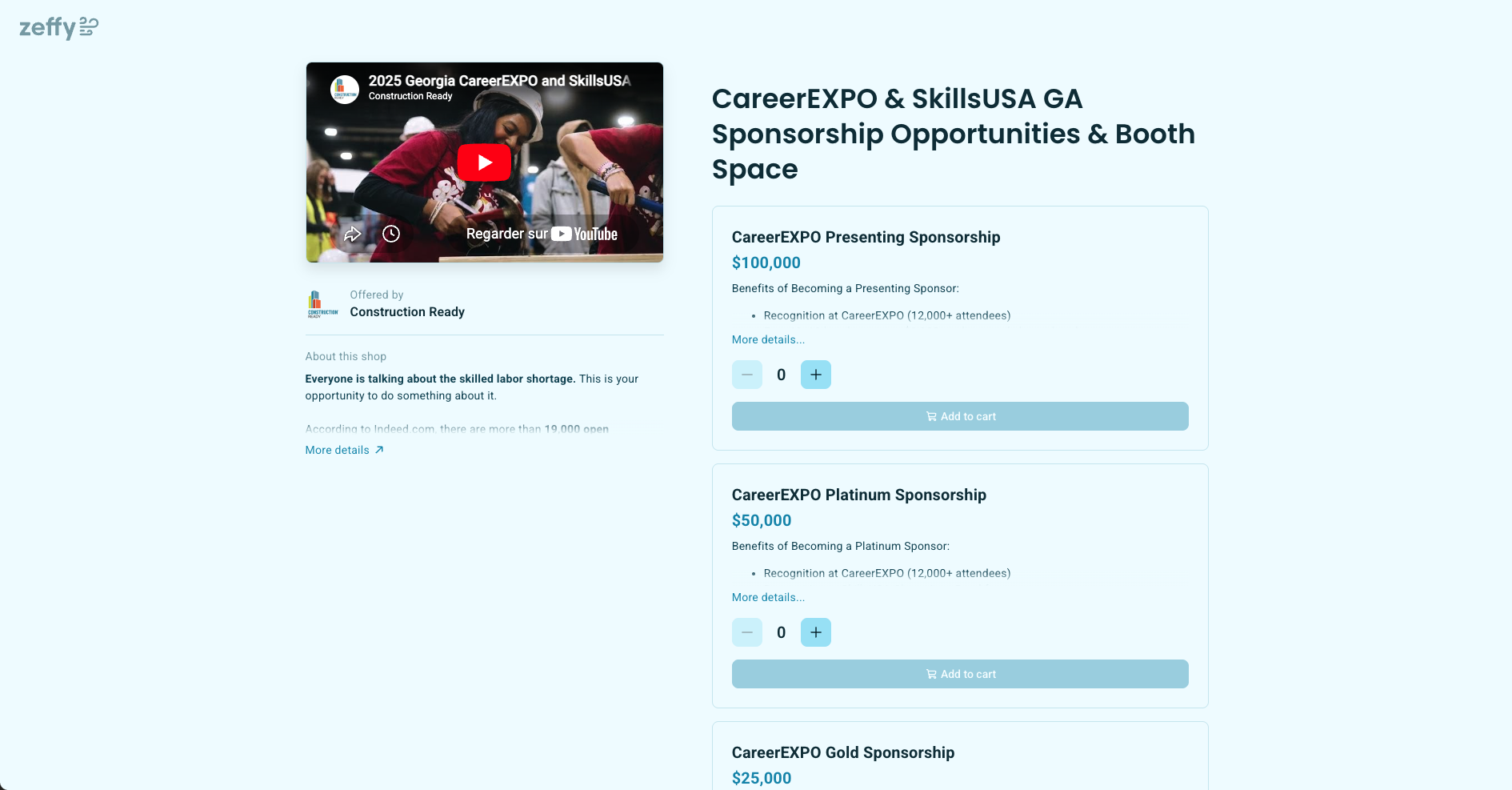
Zeffy is trusted by 100,000+ nonprofits that have raised over $2B on the platform. You can build a sponsorship page in about an hour using Zeffy's free donation forms (for evergreen sponsorship pages) or Zeffy's event ticketing (when sponsorships are tied to a specific event with tier inventory caps). Here's the setup:
1.Set up your tiers. Create one ticket type or preset amount per sponsorship level — Title, Presenting, Community Champion, etc. Cap inventory where exclusivity matters ("only one Title sponsor").
2.Add compelling visuals. Photos from actual programs, not stock images. If you need product-style cards with photos for each tier, Zeffy's online store handles that.
3.Write benefit descriptions for each tier. Quantified, sponsor-facing language. "Logo in front of 1,200 attendees and 8,000 social impressions" beats "great visibility."
4.Add credibility elements. Brief mission statement, current sponsor logos, one impact stat with a number.
5.Share the link everywhere. Email signature, newsletter, donation form footer, event materials, board outreach.
Tracking sponsors as a segment is just as important as collecting their gift. In Zeffy's donor management, tag every sponsor with "Sponsor 2026," segment by renewal cycle, and schedule quarterly impact-update emails — the "After the Yes" workflow that drives renewals.
Combined, these three organizations kept over $18,000 in their budgets that would have otherwise gone to payment processors — while making it easier for corporate decision-makers to sponsor them directly online.
Renewals are won in the months between the check and the next ask. A three-phase approach keeps sponsors warm without overwhelming your team:
Immediate (within 24–48 hours). Send a personalized thank-you email referencing their specific sponsorship and the impact it funds. Post the social-media recognition (with their approval). Add their logo to every promised placement. Send the tax receipt automatically (Zeffy generates these on every transaction — see donation receipts).
Ongoing (monthly or quarterly). A monthly impact update doesn't need to be fancy — a three-sentence email with one strong photo works. The goal is keeping their logo and your mission top of mind. Quarterly cadence is the floor for renewable sponsorships.
Annual (renewal conversations). Start renewal conversations three months before their next budget cycle — for most companies setting January budgets, that means September outreach. Share a one-page annual impact report with metrics, photos, and one participant story. Ask for honest feedback before you ask for the next gift.
Corporate sponsorship tax considerations
A practical overview — not legal or tax advice. Consult a tax professional for your specific situation.
For the business: Sponsorship payments are generally deductible as either a charitable contribution or a business marketing expense, depending on what the sponsor receives in return. The IRS draws the line based on whether the benefits constitute a "substantial return benefit." See IRS Publication 526 for the current rules.
For your nonprofit: Most "qualified sponsorship payments" are not treated as unrelated business taxable income (UBTI). But if you provide the sponsor with advertising (as opposed to acknowledgement), the payment can shift into UBTI territory. The National Council of Nonprofits guide to corporate sponsorships has a clear breakdown of the acknowledgement-vs-advertising distinction.
Documentation: Keep records of every benefit you provide each sponsor (logo placements, comp tickets, ad space, speaking time). At year-end your CPA will need this to classify the income correctly.
A sponsorship is a value exchange — the business gives money or resources and receives defined benefits in return (logo placement, recognition, audience access). A donation is a gift with no benefits expected back. The IRS treats them differently for tax purposes.
Tie your ask to the value you can deliver. Quantify the exchange: number of attendees, social impressions, email reach, signage placements. A $5,000 ask is reasonable if you can deliver 1,000+ attendees and 8,000+ social impressions; $500–$1,000 is appropriate for smaller community events. Most small nonprofits start with a $2,500 Community Champion tier as the anchor.
Plan for 3–6 months of relationship building before the first ask, then 30–60 days for proposal review and internal approvals. Total: 4–8 months from first contact to signed agreement. National brands like Wells Fargo require 90 days of lead time minimum just for the application review.
Yes — in fact, local businesses prefer sponsoring small nonprofits because the audience overlap is tighter and the recognition is more visible. Start with neighborhood businesses that know your impact, then graduate to regional and national programs once you have a track record to point to.
Defined, measurable benefits: logo placement on event materials, recognition in newsletters and social media, speaking opportunities, employee volunteer days, VIP event access, and the marketing value of being associated with a cause their customers care about. The clearer you make the exchange in your proposal, the easier the yes.
Event sponsorship is the most common starting point because it offers immediate, measurable exposure that's easy for a busy executive to evaluate and approve. Cash sponsorship is the most common form within event sponsorship, followed by in-kind donations of food, venue, or media.
Get weekly fundraising tips from nonprofits experts
Thank you! Your submission has been received!
Oops! Something went wrong while submitting the form.
Keep reading :
Nonprofit life
50+ Companies That Donate to Nonprofits (2026 Guide)
Discover the best companies to approach for grants and sponsorships. Explore the types of nonprofits they typically donate to and the giving programs they conduct.
Look for people who attend related events, follow relevant Facebook groups, or subscribe to aligned newsletters.These aren’t just potential donors—they’re your future advocates.
Look for people who attend related events, follow relevant Facebook groups, or subscribe to aligned newsletters.These aren’t just potential donors—they’re your future advocates.






.webp)

