We use cookies to improve your experience on our platform. By clicking “Accept all cookies”, you agree to the storing of cookies on your device to enhance site navigation, analyze site usage and assist in our marketing efforts.
Cookies required for basic website functionality.
Cookies used to deliver content most relevant to you and your needs.
Cookies used to deliver content most relevant to you and your needs.
Cookies that help understand the performance of the website, how users interact with it and to identify bugs.
How is Zeffy free?
How is Zeffy free?
Zeffy relies entirely on optional contributions from donors. At the payment confirmation step - we ask donors to leave an optional contribution to Zeffy.
What Is a Chinese Auction? Rules, How It Works & Setup Guide (2026)
April 21, 2026
⚡TL;DR — The Short Answer
Verdict: A Chinese auction (also called a tricky tray or penny social) is one of the most accessible and engaging fundraising formats for nonprofits — and Zeffy lets you run ticket sales for it with zero fees.
What works: Tiered ticket pricing, strategic prize display, and combining the event with a gala or dinner to maximize per-attendee revenue.
What doesn't: Skipping the legal research. Most states classify these events as charitable raffles and require a permit before you sell a single ticket.
Best for: Nonprofits of any size looking for an interactive, low-barrier fundraising event that blends raffle excitement with auction strategy.
Worth considering if: You want donors to feel in control of their giving — they choose which prizes to compete for, which keeps engagement high all night.
Think of an event where the suspense of a raffle meets the excitement of an auction — that's the magic of a tricky tray, Chinese auction, or penny social. This unique blend offers nonprofits a fresh way to engage donors and boost revenue. Our guide covers everything from the official rules to step-by-step planning, prize ideas, and a real case study showing $39,935 raised with zero platform fees.
What is a Chinese auction?
A successful Chinese auction, Chinese raffle, tricky tray, or penny social offers a unique twist on traditional fundraising events. It combines elements of both silent auctions and raffles, creating an engaging experience for participants.
This format encourages active participation and allows attendees to strategize their ticket placement. It also creates a sense of anticipation as winners are revealed, making the fundraising event fun and effective for nonprofits.
Origin of the phrase: Why is it no longer called a Chinese auction?
While tricky trays were initially known as Chinese auctions, they have nothing to do with Chinese culture. It stemmed from an offensive 19th-century slur equating "Chinese" with cheap.
During that era, many Chinese immigrants faced discrimination and unfair wages. The term "Chinese auctions" became a degrading slang for shoddy quality. Since these raffles involved inexpensive raffle items, the derogatory label stuck.
Organizations now opt for inoffensive alternatives to a Chinese auction, like:
Before you start selling tickets or setting up prize tables, you need to understand the rules that govern a Chinese auction. Getting the details right keeps things fair, fun, and legally compliant — and it prevents the disputes that can sour an otherwise great event.
Ticket denominations and purchasing
Most Chinese auctions use a tiered ticket system. Common structures include:
1 ticket for $1, 6 tickets for $5, or 25 tickets for $20
Strip tickets (pre-perforated sheets) that guests tear apart and drop individually into bowls
A maximum ticket purchase limit per person (optional, but useful for keeping competition balanced and prizes accessible to all guests)
There's no universal rule on denominations — you set them based on your audience and prize values. Higher-value prizes often warrant a separate, higher-denomination ticket (for example, a $5 ticket specifically for a vacation package), which you can run as a parallel raffle alongside the main event.
Ticket placement rules
Each guest keeps one half of their ticket stub and drops the other half into a bowl or container placed in front of the prize they want to win. Communicate these rules clearly at the start of the event:
Guests may place as many tickets as they want into any bowl, including splitting tickets across multiple prizes
Tickets must be placed before the designated cutoff time, typically announced 15 to 30 minutes before the drawing
Once a ticket is placed in a bowl, it cannot be moved or retrieved
Guests should print their name or contact information on ticket stubs to avoid disputes during winner notification
The drawing procedure
At the end of the event — or at scheduled intervals throughout — a neutral party draws one ticket from each prize bowl. That person should ideally not be participating in the auction themselves. Best practices include:
Mixing or agitating the bowl thoroughly before drawing
Having a volunteer or emcee announce each winner publicly
Verifying the winner's matching stub before awarding the prize
Moving unclaimed prizes to a secondary drawing if the winner can't be located within a reasonable window, typically 10 to 15 minutes
What happens in a tie
Because each ticket stub is unique, true ties are mathematically impossible in a standard Chinese auction — only one ticket is drawn per prize. However, if a stub is lost or unreadable, organizers should have a documented contingency: re-draw from the bowl, or hold the prize until the issue is resolved. Establishing this policy in writing before the event prevents disputes on the night.
Age restrictions
Because Chinese auctions involve paid tickets and chance-based prize drawings, many states treat them similarly to raffles. Most organizations set a minimum age of 18 years for ticket purchasing, though some events allow minors to participate with parental consent. Always check your local jurisdiction's rules before setting your policy.
Legal and licensing requirements by state
This is the most commonly overlooked rule — and the one with the biggest consequences. In the United States, Chinese auctions are legally classified as charitable raffles in most states, which means:
You may need a raffle license or charitable gaming permit before selling tickets
Some states, including New York, California, and Pennsylvania, have specific filing requirements, prize value caps, or restrictions on who can conduct the drawing
A few states prohibit paid raffles of any kind, even for nonprofits
Proceeds must typically be used for the nonprofit's stated charitable purpose
Before planning your event, contact your state's charitable gaming or attorney general's office to confirm what permits apply. Requirements vary significantly by state and can change year to year. See the full legal section below for more detail.
Chinese auction vs. silent auction vs. raffle
Donors and organizers often confuse these three formats. They share surface similarities — prizes, competition, excitement — but the mechanics are meaningfully different. Knowing the distinctions helps you choose the right format for your audience and fundraising goal.
Feature
Chinese Auction (Tricky Tray)
Silent Auction
Raffle
Ticket / bid structure
Paid tickets dropped into prize-specific bowls
Written bids on bid sheets
Numbered tickets entered into a single draw
Bidding method
Ticket placement (strategic allocation)
Dollar-amount bids, open to all items
No bidding — pure chance
Winner selection
Random draw from each prize bowl
Highest bid wins
Random draw from full ticket pool
Participant strategy
Yes — allocate tickets to preferred prizes
Yes — outbid competitors
None — outcome is entirely random
Minimum entry cost
Low (often $1 per ticket)
Typically tied to minimum bid (can be high)
Low to moderate (varies by ticket price)
Best for
Broad audiences, community events
Higher-value items, affluent donor base
Simple, low-overhead fundraising
Typical fundraising range
$5,000–$50,000+ depending on event size
$10,000–$100,000+
$500–$20,000
Legal classification
Charitable raffle (most states)
Generally no gaming license needed
Charitable raffle (most states)
The Chinese auction format sits in a sweet spot. It's more engaging than a standard raffle because donors feel invested in specific prizes. It's more accessible than a silent auction because the entry cost is low — anyone can throw in a $1 ticket and have a real shot at winning. That combination makes it particularly effective for community-based nonprofits running annual fundraising events.
One practical note: if you're planning to run both a silent auction and a tricky tray at the same event, keep the two formats physically separate and clearly labeled. Mixing them causes confusion about bidding rules and can slow down your drawing.
Legal considerations and state regulations
Running a Chinese auction without the right permits is one of the fastest ways to turn a successful fundraiser into a legal headache. Because the format involves paid tickets and a chance-based drawing, most states classify it as a charitable raffle or charitable gaming activity — and both come with regulatory requirements.
What permits you may need
Requirements vary significantly by state, but the most common include:
A charitable gaming license or raffle permit issued by your state's attorney general, gaming commission, or secretary of state
Pre-event registration of your organization as a qualified nonprofit (usually requiring 501(c)(3) or equivalent status)
A cap on total prize value per event in some jurisdictions
Restrictions on who may operate the drawing (some states require a licensed member of the organization, not a paid contractor)
Post-event financial reporting showing how proceeds were used
Some states also require that tickets display specific disclosures, such as the nonprofit's name, the date of the drawing, and the ticket price.
State-by-state variation
A few patterns worth knowing:
New York: Requires a Games of Chance License for most raffle-style events. Organizations must register with the state and file post-event reports.
California: Raffle permits are issued by the Department of Justice. At least 90% of net proceeds must go to the charitable purpose.
Pennsylvania: Has specific small games of chance regulations that apply to many nonprofit fundraisers, including tricky trays.
Texas: Charitable raffles are permitted only for qualified organizations during their regular meetings, with specific restrictions on prize types.
Some states (historically including Hawaii and Utah, though laws change) have prohibited paid charitable raffles entirely, even for nonprofits.
Because laws change and local ordinances can add additional layers, don't rely on this list alone. Contact your state's charitable gaming office or attorney general directly before selling tickets.
Compliance tips for organizers
Apply for any required permits at least 60 to 90 days before your event — processing times vary widely
Keep a written record of all ticket sales, prize values, and proceeds
Document your drawing procedure and designate a neutral drawing official before the event
Consult a nonprofit attorney if your event involves high prize values or multi-state attendees
Getting compliance right protects your organization's reputation and its ability to fundraise in future years.
Chinese auction variations
The classic tricky tray format is just the starting point. Many nonprofits put their own spin on the format to match their audience, increase revenue, or adapt to different event settings.
Themed tricky trays
One of the most popular variations is building your entire event around a theme — and organizing prize baskets to match. A "Night in Italy" event might feature baskets filled with wine, pasta-making kits, and restaurant gift cards. A "Spa Day" theme might cluster wellness products, massage vouchers, and skincare sets. Themed events are easier to market, easier to decorate, and tend to generate stronger word-of-mouth because they feel like a cohesive experience rather than a table of random items.
Theming also makes basket procurement easier. When you're asking local businesses for donations, a specific theme gives them a clear brief. A local wine shop knows exactly what to contribute to an "Evening in Tuscany" basket — they don't need to guess.
Virtual and online Chinese auctions
Virtual tricky trays moved from novelty to necessity during the pandemic and have stayed popular because they remove geographic barriers. Online participants purchase tickets through a platform, indicate which prizes they want to enter, and a live-streamed drawing reveals winners in real time.
Running a virtual version works best when you keep the prize list focused (fewer items, higher individual value) and invest in a smooth live stream with a charismatic host. Shipping logistics for physical prizes add complexity — factor that cost into your prize budget or prioritize digital and experience-based prizes (gift cards, subscriptions, event tickets, service vouchers) for online events.
Hybrid formats
A hybrid event combines an in-person tricky tray with an online ticket-selling component, so supporters who can't attend in person can still participate remotely. In-person guests pick up physical tickets at the door, while online participants purchase tickets through a link and have their stubs entered into the relevant bowls by a volunteer on-site. Winners are announced via live stream and personally contacted.
Hybrid events can significantly increase your reach and total ticket revenue, but they require more coordination. Assign a dedicated volunteer to manage the online ticket pool and communicate with remote winners promptly.
Multi-round drawings
Instead of doing a single drawing at the end of the night, multi-round formats hold drawings at scheduled intervals (for example, every 30 minutes). This keeps energy high throughout the event, gives early winners a reason to stay, and creates natural moments for your emcee to re-engage the crowd with your mission.
A practical approach: designate the first few rounds for mid-tier prizes and save the biggest items for the final drawing. It gives latecomers a full shot at the top prizes while rewarding early arrivals with earlier wins.
High-ticket parallel raffles
For premium prizes that might get overlooked in a sea of $1 tickets, run a separate higher-denomination ticket raffle in parallel. A vacation package, a piece of original art, or a premium tech item might use $10 or $25 tickets sold separately. This preserves the accessibility of the main tricky tray while creating a higher-stakes parallel game that appeals to donors with more to spend.
How does a Chinese auction work?
Here's a breakdown of how these raffle-styled fundraisers operate:
Ticket purchase: Bidders buy tickets for the charity auction. Since bidding takes place with tickets, there are no rules on how many can be purchased.
Prize display: Guests explore all the raffle items or prizes, which are displayed like a silent auction. These can include experiences, products, raffle baskets, and other items.
Bidding process: To place bids, attendees leave tickets in the box/jar/bowl in front of their favorite items. You can allow guests to place as many event tickets as they want or limit the number.
Winner selection: Once bidding ends, the emcee draws a winning ticket for each item and decides on the winner.
Prize collection: Winning guests can collect their prizes immediately or later, depending on whether the event is a standalone or combined with other fundraisers.
6 steps for organizing a penny social auction to raise money
1. Set a fundraising goal and budget
Begin with a clear, achievable fundraising target. Consider your specific needs, required funding, and timeline. For example, you might aim to raise $20,000 for shelter renovations within three months.
Next, create a detailed budget. Account for venue costs, marketing expenses, supplies, decorations, and raffle software fees. (Unless your nonprofit organization is using Zeffy, the 100% free online raffle platform — trusted by 100,000+ nonprofits and used to raise over $2 billion for charitable causes.)
2. Assemble an auction committee
Penny socials require all hands on deck. Creating an auction team will ensure that no single person is overloaded with responsibilities.
While it's good to appoint only one event coordinator to lead the planning and execution process, you'll also need these key players to get things done:
Procurement: One to three people to solicit items from donors and companies
Logistics: One to four people to handle the venue, invites, catering, and more
Marketing: One to three people to promote your event and sell raffle tickets
Emcee: Someone with a bright personality who can host the event and ensure guests are having fun
Volunteers: Five to six people to help out on the auction day with tasks like setup, check-in, check-out, and more
The size of your auction team will ultimately depend on the organization's size, but ensure your committee has these roles defined.
3. Select a venue
Once you've decided on the date and time for your penny social, start looking for your venue. Here are some key factors to consider that will help you pick the perfect venue:
Capacity and facilities: Estimate a tentative guest count for your auction and ensure your venue comfortably accommodates all attendees and has essential facilities like restrooms
Location and parking: Choose a location easily accessible to attendees with ample parking space
Layout and ambiance: Ensure the layout is ideal for displaying auction items properly and allows space for smooth traffic flow
Cost and availability: Check if the venue is available on your preferred date and time and fits your budget
4. Decide your prize items
Auction items will drive people to your fundraiser and encourage them to purchase multiple event tickets. Try to procure one or more big-ticket items, like concert seats or new tech, plus several smaller items.
Here are some ways to find item donations:
Reach out to companies that donate to nonprofits to request in-kind or cash donations
Partner with local businesses and storefronts — they often provide auction fundraiser items as a way to give back to the community
Ask your volunteers to reach out to their network to secure donations
Ask your staff and board members whether they can contribute prizes or connect you with potential sponsors
Some popular items to consider selling at your penny social auction event include:
Gift baskets designed around a theme
Unique pop culture goods and experiences
Vacation packages
Lessons or personal training certificates
Gift cards from local businesses
Gourmet food and drink packages
5. Promote your penny social event
The best way to ensure maximum participation is to use multiple marketing channels to promote your penny social. For the widest reach, prioritize the following channels:
Email marketing: Include sections about your auction in your monthly and quarterly newsletters sent out in the lead-up to the event. Create separate email blasts focused on the auction.
Social media: Post about your auction early and frequently on all of your organization's social media accounts and include a link to your sign-up form
Direct mail: To give recipients the choice of how to sign up, consider including both a physical RSVP card with a prepaid return envelope and a QR code to an online registration form.
Local media: Share press releases about your event with local newspapers and magazine publishers. Contact a local radio show and other media to announce your auction.
6. Sell admission or raffle tickets
Offer multiple purchase options, including online pre-sales, physical ticket booths, and at-the-door sales. Create tiered ticket packages to cater to different budgets and preferences. You can host both an online and a physical event for supporters to bid on items.
During your auction, periodically update participants on leading bids for items. This creates a sense of urgency and encourages others to increase their bids, leading to more sales.
2. Create ticket packages
Provide different ticket packages in different tiers to cater to various donation preferences and financial capacities. For instance, standard prizes are one ticket per entry, big prizes are five raffle tickets per entry, and mid-level prizes are around two to four tickets.
Consider making the tricky tray fundraisers part of a larger fundraising event, such as a gala or dinner. This approach can enhance the overall experience, attract a wider audience, and potentially increase donations by offering multiple ways for attendees to contribute.
4. Socialize with your guests
Spend some time mingling with your guests before the penny social starts or as they browse your items. This will help you find new supporters and deepen your ties with existing donors.
5. Set up a donation box
Set up one or two donation boxes at the venue. Even if it's a ticketed fundraising event, some guests can still decide to give small cash donations. Incorporate QR codes on these boxes to allow online donations as well.
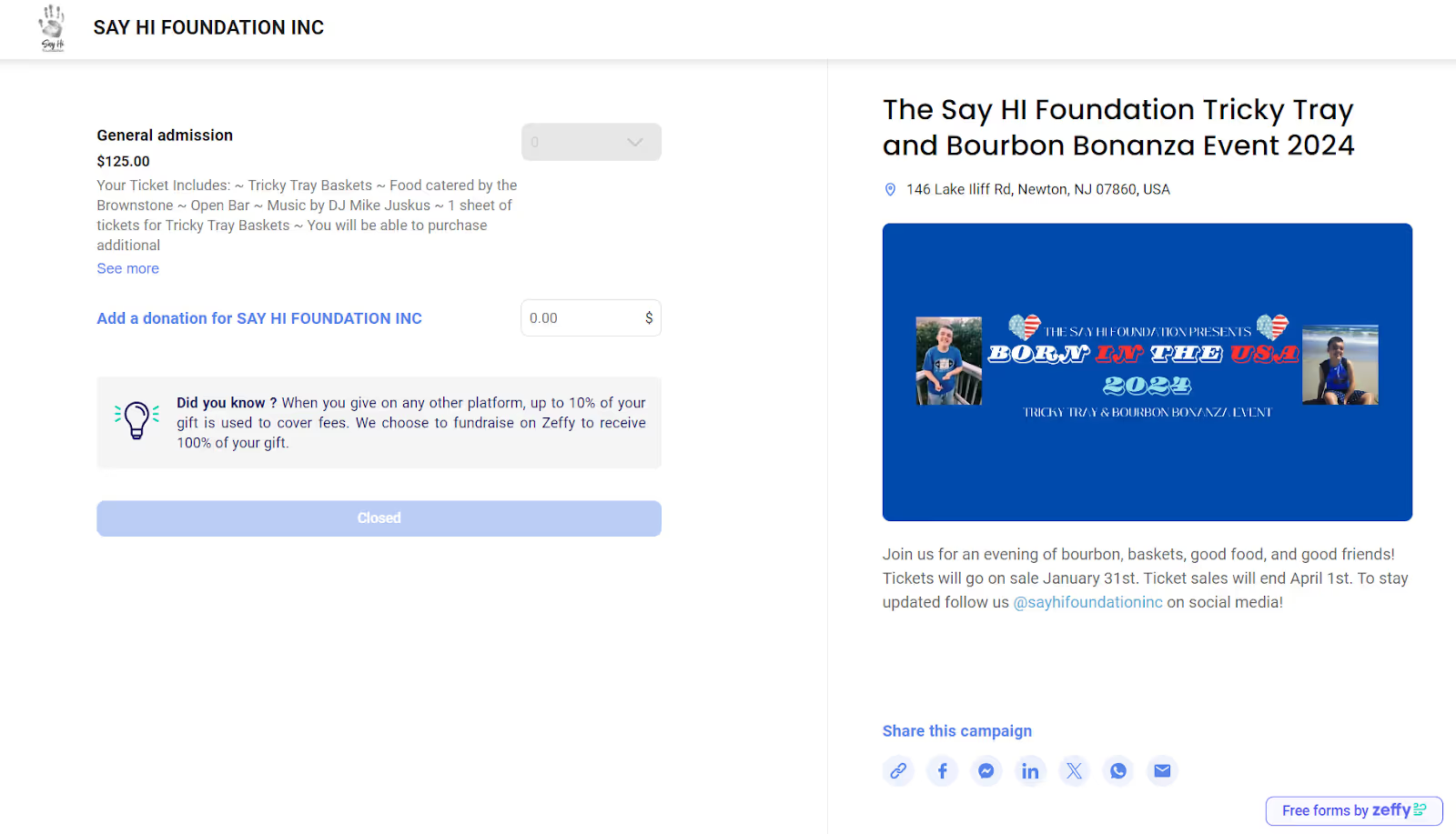
Case study: How Say Hi Foundation sold tricky tray tickets using Zeffy and saved $39,935
The Say Hi Foundation Inc. successfully used Zeffy's online raffle platform for their 2024 Tricky Tray and Bourbon Bonanza Event. This creative fundraiser combined a tricky tray with a bourbon-themed gathering, appealing to a diverse audience. They created a high-value experience for attendees by offering general admission tickets that included tricky tray baskets, catered food, an open bar, and live music.
Using Zeffy's free ticketing system, they raised an impressive $39,935 and saved $2,000 in fees. This event shows how cost-effective — and better, free — online tools can significantly boost a nonprofit's fundraising potential and community engagement.
Every dollar that would have gone to platform fees stayed with Say Hi Foundation's mission instead. That's the core of what zero-fee fundraising means in practice: more money reaching the people you serve, not the platform you use. Zeffy has helped 100,000+ nonprofits raise more than $2 billion for their causes — with no platform fees, ever.
Guests buy tickets and drop them into bowls in front of the prizes they want to win. At the end of the event, a neutral party draws one ticket from each bowl. The holder of the matching stub wins that prize. Guests can place as many tickets as they want into any bowl, but once a ticket is placed, it can't be moved. Tickets must be placed before the announced cutoff time.
In most U.S. states, Chinese auctions are classified as charitable raffles and require a raffle license or charitable gaming permit before you sell tickets. Requirements vary by state — some states have prize value caps, specific filing deadlines, or restrictions on who can run the drawing. Always check with your state's attorney general or charitable gaming office before your event.
Ticket prices vary by organization and prize tier, but common structures include $1 per ticket, $5 for 6 tickets, or $20 for 25 tickets. Higher-value prizes sometimes use separate, higher-denomination tickets (for example, $5 or $10 per entry). The low entry cost is part of what makes the format accessible to broad audiences.
In a silent auction, participants write dollar-amount bids on bid sheets, and the highest bidder wins. In a Chinese auction, participants buy tickets and place them in bowls for specific prizes — the winner is chosen randomly. Silent auctions tend to favor higher spenders; Chinese auctions give every ticket holder an equal chance regardless of how much they spend overall.
Yes, a penny social is a game of chance where the winner is randomly picked. Like a silent auction, items are displayed to attendees. But instead of directly bidding, participants place tickets in a basket assigned to the item they want. Once the event ends, the emcee pulls a ticket for each item and announces the lucky winner.
Tricky tray baskets are prize items in penny social auctions organized as part of fundraisers or events to raise money for a charitable cause. Each basket is loaded with goodies that encourage guests to purchase tickets for a chance to win.
How to Plan and Run a Raffle Fundraiser (Free Guide + Planner)
Plan your raffle in 60 seconds with our free revenue planner. Then follow 10 steps to set up, promote, and run a raffle that keeps 100% of what you raise.
Look for people who attend related events, follow relevant Facebook groups, or subscribe to aligned newsletters.These aren’t just potential donors—they’re your future advocates.
Look for people who attend related events, follow relevant Facebook groups, or subscribe to aligned newsletters.These aren’t just potential donors—they’re your future advocates.







.webp)

