How is Zeffy free?

How is Zeffy free?
Zeffy relies entirely on optional contributions from donors. At the payment confirmation step - we ask donors to leave an optional contribution to Zeffy.
Learn more >

You cannot write a personalised "we miss you" letter to a donor you cannot even find. For most small charities, that is the real lapsed-donor problem: giving history lives in three different Google Sheets, a Gmail contacts dump, a paper deposit book, and last year's event export. The clever subject line is the easy part. Getting every donor into one place, tagging the ones who have not given in 12+ months, and segmenting by recency is the unglamorous work that decides whether your re-engagement campaign actually works.
This guide walks through that workflow in order: consolidate first, tag and segment second, then send the right template to the right bucket. After that, the channel choices, the nine-question survey, the three sample letters, and the automation setup all fall into place.
In this article:
Most re-engagement guides open with subject lines. That is the wrong end of the workflow. At a small charity, donor history almost always lives in more than one place: a Google Sheet from the 2023 gala, a Gmail contacts list, an event ticketing export, a payment processor report, maybe a paper deposit book. Many charity staff describe the manual reality plainly. They open Gmail and add contacts one by one to send a single email blast.
If you cannot find the donor, you cannot personalise the ask. If you cannot personalise the ask, the template does not matter. So the spine of this article is: step zero is consolidation and tagging. Then cadence. Then templates. Retaining a donor you already have is generally less expensive than acquiring a new one, which is why this workflow earns its time.
For a small charity: if your donor list is scattered, fix that before you write anything. A one-afternoon cleanup beats a quarter of clever copy that lands in the wrong inboxes.
A lapsed donor is anyone who used to give and has not done so in a while. Pick the "while" that fits your charity. Common cutoffs are six months, 12 months, 18 months, and 24 months. Most charities use 12 months as the default because it covers a full giving cycle (annual appeals, year-end, anniversary gifts).
For context, NCVO notes that UK charities face a significant donor retention challenge: most lose more than half of their donors year to year. Lapsed donors are not a fringe audience. They are most of your file.
In the UK, a reactivated donor is often more valuable than a new one for a reason many guides miss: Gift Aid stacks on every eligible gift. If your lapsed donor was giving with Gift Aid before, you may already have the declaration on file. Reactivate the relationship and you reactivate 25p per £1 in HMRC recovery too. A reactivated £100 gift with Gift Aid is worth £125 to your charity, at no extra cost to the donor (Gift Aid, gov.uk).
Lapsed donors are also warm leads. They opted in once. They know your mission. They have already trusted you with a payment. Reaching out to them takes less effort than finding a brand-new donor from scratch.
For a small charity: set one definition and apply it consistently. Splitting hairs over 11 versus 13 months matters less than picking a number and actually running the workflow against it.
Donors do not usually lapse out of anger. They lapse out of life. Common reasons, in plain terms:
For a small charity: you do not need to diagnose each donor individually. Pick the two reasons most likely to apply to your file and design your re-engagement copy around those.
This is the step that most articles skip. Before you can re-engage anyone, every donor needs to be in one place where you can search, filter, and tag them. That is it.
Pick one source of truth. A free supporter CRM with tags and smart filters works. So does a single well-built spreadsheet if you are under a few hundred contacts. The point is not the tool; it is the consolidation.
The cleanup itself:
Treat this as a one-afternoon job, not a quarter-long project. Perfect is the enemy of done. You can always clean up the notes field next month.
For a small charity: the goal of this step is not a perfect database. It is a searchable one. If you can filter "last gift before [date]" and see the list, you are done.
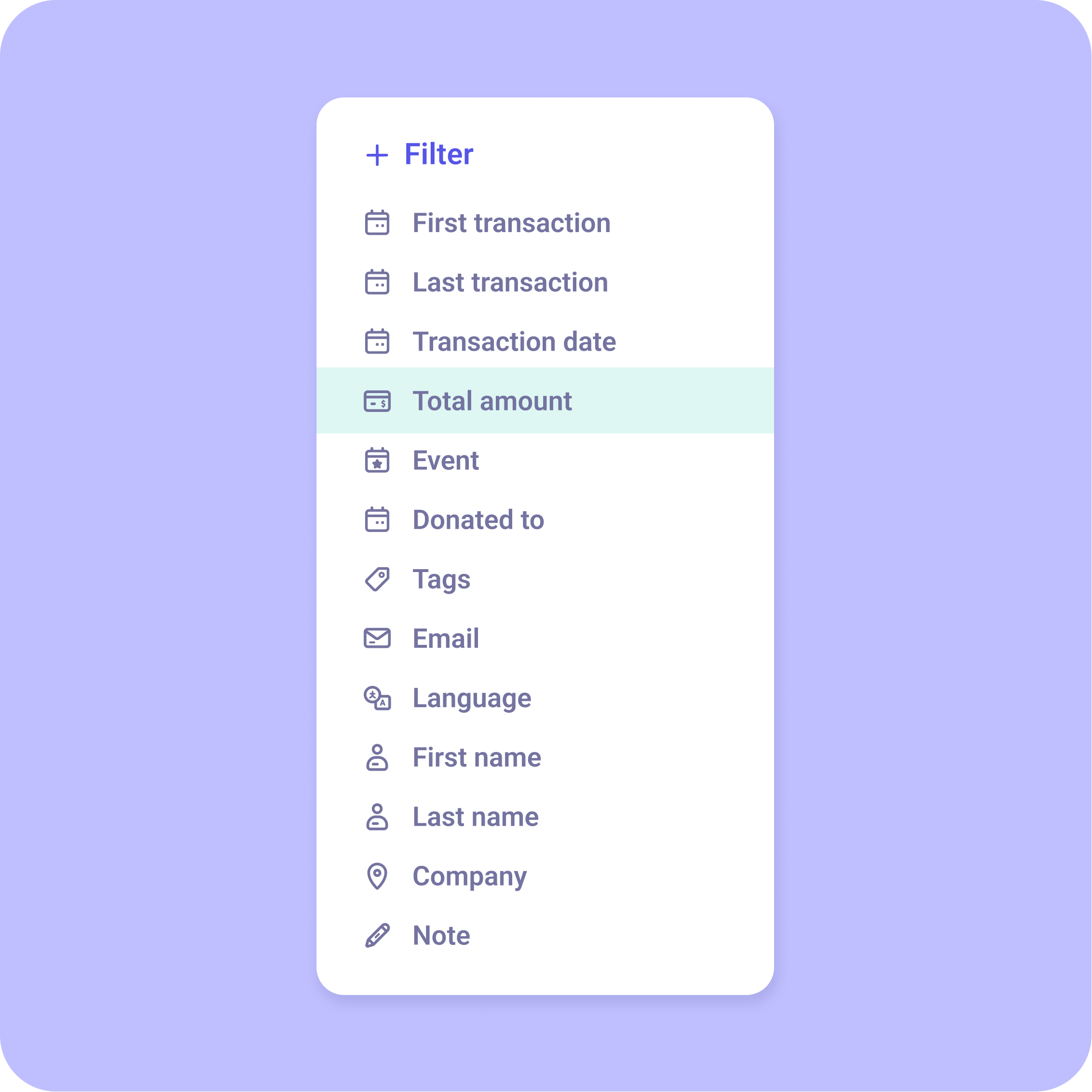
Now that every donor is in one place, build the segments.
Run a filter for anyone whose last gift was 12+ months ago. That is your lapsed pool. Apply a tag (literally type "lapsed-2026" or whatever convention works for you) so you can pull this segment up later in one click.
Then split the lapsed pool into three recency buckets:
If your list is large enough, add a second cut by past giving level (under £25, £25 to £100, £100+). Higher-value lapsers earn a phone call or a physical letter. Smaller-value lapsers get email.
A simple prioritisation layer some organisations use: a donor score that combines giving history with recent email engagement (opens, clicks). If a two-year lapser still opens your newsletter, they are a higher-priority contact than one who has gone dark across every channel. This is a useful pattern when your list is too large to reach everyone at once; it is not a universal rule.
Before you send, also check that Gift Aid declarations on file are still valid. Declarations do not expire, but donor addresses do, and HMRC requires the donor's current home address for a valid claim. A re-engagement email is a low-friction moment to refresh the declaration.
For a small charity: three recency buckets is enough. Do not build twelve segments on day one. You will not use them.
Each bucket gets its own cadence and its own template angle.
Across all three buckets, the same seven principles apply. Each is doing real psychological work, not just sounding nice.
For a small charity: if you only have time for one touch per bucket this quarter, send the third touch from the recent-lapser sequence (the actual ask). It is the highest-yield single message in the whole workflow.
Different segments respond to different channels. Pick by bucket, not by your own preference.
The workhorse channel for the six-to-12-month and most of the one-to-two-year buckets. Subject lines should be specific and human ("We miss you, [first name]" beats "An important update from [org]"). Optimal send times for charities are typically Tuesday through Thursday mornings, but the best time is the time you will actually send, not a theoretically perfect slot you will skip. Send re-engagement emails from your dashboard so you can see opens, clicks, and donations against the same segment list.
Before you send anything, confirm you have a lawful basis under UK GDPR to contact each donor for marketing purposes. Existing donors who gave through your website usually fall under the soft opt-in (with a clear unsubscribe in every message); donors from third-party lists, event ticket buyers, or paper deposit slips may not. The ICO published updated soft opt-in guidance for charities in 2026. Check it before your first campaign. The Fundraising Regulator's Code of Fundraising Practice also governs how and when you contact lapsed donors.
Physical letters outperform email for deep-lapse (two-plus year) and higher-value donors. Royal Mail second-class or franked mail is standard for UK charity direct post; a hand-addressed envelope still outperforms a window-envelope printed appeal for deep-lapse donors. Use post when email re-engagement attempts have not worked, or when the donor was historically a £100+ giver.
Reserve for top-tier lapsers (past major donors, multi-year regular givers who dropped). A 90-second warm call from a real person ("Hi, I am calling from [org]; I wanted to thank you for your support over the years and see how you are doing") beats any letter. Do not lead with the ask. Lead with the relationship.
Use SMS only with donors who explicitly opted in to text communications. Under PECR (Privacy and Electronic Communications Regulations), enforced by the ICO, you need prior explicit consent for SMS marketing to individuals. The soft opt-in that applies to email does not apply to text. UK GDPR governs the underlying data processing. SMS works best for confirmations and reminders, not cold re-engagement. You will need a separate SMS tool to run this channel.
| Segment | Primary channel | Backup |
|---|---|---|
| 6–12 months | Text (if opted in) | |
| 1–2 years | Email + mail | Phone for higher-value |
| 2+ years | Phone for major past donors |
For a small charity: email handles 80% of the work. Add post or phone only for the segments where the maths (higher gift size) justifies the time.
After your initial re-engagement sequence, some donors will not respond. Before you give up on them, send a short survey. The goal is not to land another gift; it is to learn why they left so you can fix the upstream cause.
Act on responses individually where the gift size justifies a personal reply, and aggregate the rest into a quarterly review of what to change.
For a small charity: three responses are enough to spot a pattern. You do not need a statistically significant sample to learn that your acknowledgements are not arriving.
Three templates, mapped to the three recency buckets. Swap the bracketed fields for your details. The subject lines are written to get opened on a phone.
Subject: We've missed you, [Donor's Name], here's how you made a difference
Dear [Donor's Name],
How have you been? We just wanted to share some deep gratitude for your generosity to [Organisation Name] in the past. You helped us [briefly describe the impact of the donor's gift], and we cannot thank you enough.
Life changes and priorities can shift, and we appreciate the difference you made for us along the way. It is because of donors like you that [briefly highlight a recent milestone or success].
We would love to invite you back to [Organisation Name] to continue this vital work if you are open to it. Whether it is a one-off contribution or volunteering at our next event, every bit counts. If you are a UK taxpayer, ticking the Gift Aid box adds 25p to every £1 you give, at no extra cost to you.
Please get in touch if you would like to reconnect or have any questions. We are here and would love to hear from you.
Thank you again, [Donor's Name], for being part of our community. We genuinely appreciate your commitment over the last [number of months or years this donor supported you].
Warm regards,
[Your Name]
[Your Title]
[Organisation Name], Registered charity in England & Wales no. [XXXXX] (or OSCR / CCNI equivalent)
[Contact Information]
Subject: We understand, here's how you can help again when you're ready
Dear [Donor's Name],
Life can get hectic, and it is only natural that priorities shift. That is okay. We want you to know that we respect where you are and appreciate everything you have done for us.
You have been an essential part of our journey, and we wanted to take a moment to let you know that your past gifts made a real difference. Thanks to supporters like you, we have been able to [mention a specific impact].
If you are interested in returning to support us in the future, we have made it easier than ever. You can contribute in many ways: a small one-off donation, helping us raise awareness, fundraising on our behalf, or volunteering at our next event. Circumstances change, so do not hesitate to let us know if there is a comfortable way to support that would feel right for you now. Even £5 or an hour can make a real difference.
If you are a UK taxpayer and would like to Gift Aid your donation, it adds 25p to every £1 at no extra cost to you. You can also set up a regular gift by Direct Debit if that is easier to manage.
If you are ready to make an impact again, we would love to have you back. Visit [insert link] to find out how you can help, or get in touch directly with questions or ideas.
Thank you again, [Donor's Name], for your support. We genuinely hope to see you again soon.
Best wishes,
[Your Name]
[Your Title]
[Organisation Name], Registered charity in England & Wales no. [XXXXX] (or OSCR / CCNI equivalent)
[Contact Information]
Subject: [Donor's Name], here's how you changed lives
Dear [Donor's Name],
We hope you are doing well. You have been on our minds, and we thought you might enjoy this example of the difference your support has made in the lives of those we serve.
Recently, one of our [beneficiaries / service users / members, etc.] shared their story with us: [Insert a short, heartfelt story of a person impacted by the organisation].
Thanks to generous donors like you, things look different for [beneficiary or service user] this year. Stories like these remind us of why we do what we do and why we are so grateful for your help.
This is our warm invitation to rejoin the mission. Your continued support, from donations to attending our next event, will help us do even more. The future is exciting, and we would love you to be part of the next chapter.
Here is a donation page where you can contribute directly: [insert link]. Of course, you can also contact us for more information on other ways to help.
Thank you for everything, [Donor's Name]. Your kindness has already left a lasting mark, and there is so much good ahead.
With gratitude,
[Your Name]
[Your Title]
[Organisation Name], Registered charity in England & Wales no. [XXXXX] (or OSCR / CCNI equivalent)
[Contact Information]
For a small charity: personalise the first sentence and the specific-impact line. The rest of the template can stay as-is.
.png)
Once you have run the workflow manually once, automate the parts that do not need a human. The trigger criteria are simple: "days since last gift" crosses your lapse threshold (for example, 365 days). The first touch fires automatically. If the donor opens but does not give, the second touch fires a week later. If the donor opens and clicks, you escalate to a personal reply.
Personalisation fields to set up: first name, last gift amount, last gift date, last campaign supported, lifetime giving total. With those five fields, every automated email feels hand-written.
Zeffy is a free fundraising platform and CRM trusted by 100,000+ charities and not-for-profits, with more than £2bn raised. For the re-engagement workflow specifically, the relevant pieces are:
Honest scope: Zeffy handles the 80% of re-engagement work a small charity actually needs (consolidate, tag, segment, email, ask). It is not an enterprise drip-sequence engine with RFM scoring, AI churn prediction, or multi-step trigger workflows, and it does not include built-in SMS re-engagement. If you need any of those, you will need a heavier (and paid) tool stack.
For a small charity: the right free tool covers what you actually have time to use. Enterprise features cost money and admin hours small organisations do not have to spare.
Three numbers tell you whether the workflow worked.
Run the numbers after each campaign. If reactivation rate is low across the board, the problem is probably the consolidation or segmentation. If reactivation is fine for one bucket but poor for another, swap that bucket's template.
For a small charity: tracking three numbers in a spreadsheet beats not tracking at all. Do not wait for a fancy dashboard to start measuring.
The thing that makes lapsed-donor campaigns work is not a clever subject line. It is the unglamorous step-zero of getting every donor into one place, tagging the lapsed pool, splitting it by recency, and then matching template to bucket. The nine survey questions and three sample letters above are the easy part once the data is right. Build the workflow once, automate the touches that do not need a human, and your next re-engagement campaign starts from a much higher floor than your last one.
If your charity is not yet HMRC-recognised for Gift Aid, that is the single highest-ROI admin task before your next re-engagement campaign. HMRC's Charities Online is free to register for, and it means every reactivated basic-rate gift is worth 25p per £1 more to your cause.
The natural next step after a re-engagement campaign is keeping reactivated donors from lapsing again. That is the territory covered in our donor retention plan guide.
Most charities define a lapsed donor as someone who has not given in the past 12 months. This covers a full giving cycle, including annual appeals and year-end campaigns. You can set a shorter window (six months) for higher-frequency donors or a longer one (18 to 24 months) if your charity runs infrequent campaigns. What matters most is picking one definition and applying it consistently.
Lead with gratitude and impact, not an immediate ask. Your first contact should thank the donor for past support and share one specific outcome their gift helped fund. Save the direct ask for the second or third touch. A tone that acknowledges life gets busy (and says so plainly) tends to outperform guilt-heavy copy. The Fundraising Regulator's Code of Fundraising Practice also sets clear expectations for respectful donor contact.
Yes. Gift Aid declarations do not expire. However, HMRC requires the donor's current home address for a valid claim, so if your records are out of date, use the re-engagement contact as an opportunity to refresh the declaration. If the donor has moved, ask them to confirm their new address when they give again. (Gift Aid guidance, gov.uk)
It depends on the recency bucket. For six-to-12-month lapsers, three emails over six weeks is a reasonable cadence. For one-to-two-year lapsers, four touches spread over two to three months. For two-plus-year lapsers, one strong story-driven email is usually enough for a first attempt. If there is still no response after your sequence, consider a short survey to understand why, then move the donor to a lower-frequency update list rather than removing them entirely.
Phone, without question. A 90-second warm call from a real staff member or trustee outperforms any letter or email for high-value lapsed donors. Do not lead with the ask; lead with the relationship and a genuine thank-you for past support. Follow up in writing afterwards with a personalised letter on headed paper. Post carries more weight than email for donors who gave £100 or more.
Not necessarily, but you do need a lawful basis under UK GDPR. Existing donors who gave directly through your website or forms usually fall under the email soft opt-in, provided you include a clear unsubscribe option in every message. Donors from older paper records, third-party lists, or event purchases may not qualify. The ICO published updated soft opt-in guidance for charities in 2026. Review it before you contact anyone you are unsure about, and check that your records include a valid consent or legitimate-interest basis for each segment.


A supporter retention plan is a structured approach that helps UK charities keep donors engaged, reduce attrition, and build long-term relationships. This guide covers the ten core elements every charity needs, with UK-specific grounding in Gift Aid, the Fundraising Regulator's Code of Fundraising Practice, and the segmentation strategies that work for small and mid-sized charities in 2026.


A little personalisation goes a long way in donor relationship management. This guide covers UK-specific stewardship practices: Gift Aid-aware segmentation, Fundraising Regulator Code compliance, UK GDPR and PECR rules for supporter communications, and how to consolidate your tool stack with free donor management software.

.webp)


